Entries Tagged 'life' ↓
March 2nd, 2009 — happiness, life

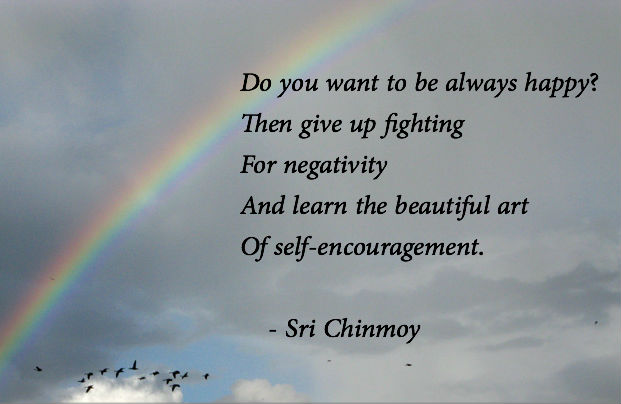
Do you want
To be happy,
Learn the beautiful art
Of self-encouragement.
- Sri Chinmoy
It is a fine balance between self encouragement and self-criticism. To honestly evaluate ourselves is a difficult task. We tend to either conveniently ignore our own faults or become too harsh on ourselves for small inconsequential things. We need a balance of self-encouragement and honest self-appraisal; getting the right balance is not so easy.
Tips for Self Criticism
Don’t Be Ashamed of your Faults.
If we can’t be honest with ourself who can we be honest with? The mind can be good at justifying our wrong actions and behaviour. But, clever self-justification is of no benefit in the long run. If we can be aware of our own pride, jealousy, insecurities then we have a chance to let go of them. But, if we always justify our wrong attitudes to ourself then we are lost.
Avoid Guilt.
One of the reasons we may seek to ignore our faults is that we feel guilty. Rather than feeling guilty we avoid criticising ourself. However, it is better to be self-critical without feelings of guilt. Guilt is an emotion that doesn’t help but makes us feel more inadequate. Become aware of what you want to change and see it is a positive movement.
Not self-contempt
But self-improvement
Has to be
Our continuous choice.
- Sri Chinmoy
Don’t Judge By The Values of Others.
The biggest problem is that we start to judge ourselves by the standards of others. Our friends may have been put out because of something we did. Therefore, they try to make us feel guilty. Because others are critical of us, we feel obliged to feel guilty too. But, we have to be firm and reject others’ criticisms – if they are not justified. In the eyes of the world we may have done something wrong. But, only we know our inner attitude. We may have done something with the best of intentions and motivations, but, because of circumstances beyond our control, thing turn out badly. The world will criticise us, but, we know we did our best. How can we criticise ourselves for bad luck or circumstances beyond our control?
- At the same time, we may get praise when we don’t deserve it.
- Also, although we shouldn’t accept the misinformed critisims of others. We should be open to the suggestions of others. Often people can see things about ourselves that we can’t. Don’t be too proud to take advice / suggestions / criticism from others. It is not a sign of weakness to listen to other people. Our sincerity will know whether they are telling the truth or not.
Judge Motives rather than Outcome.
As mentioned in the previous point it is our inner attitude which is important. A small action done selflessly without expectation of reward is worth more than egoistic selfish actions which may appear to have a better outcome. It is our inner attitude that we need to be aware of.
Remain Balanced.
When we start to criticise ourself it is easy to lose a sense of proportion and start beating ourselves up over a small issue. This is a real mistake. We might make small mistakes but, making them into big problems just makes the situation worse. Never lose a sense of proportion and don’t magnify small problems. At the same time don’t be dismissive of actions that are causing pain to others.
Self Criticism and Self Encouragement.
Focusing on the negative doesn’t help. The most effective self-criticism is to also learn the art of self-encouragement. Be aware of the good selfless deeds and thoughts you have and give these more importance. If we strengthen our good qualities then this will take care of most of our weaknesses. The positive approach is by far the best way to help our self-improvement.
photo by Pavitrata
Related Posts
February 24th, 2009 — life

People are a mixture of qualities and personalities. At various times, we all embody these different aspects and qualities. But often some quality or trait is more predominant than others. Some friends will be insecure and shy, others will be brash and egocentric. We need to respond to these different characteristics in different ways. There are also some general tips for dealing with difficult people here.
Dealing with difficult people is certainly one of the most important life skills and as painful as it maybe, dealing with difficult people can be very instructive. Even if it is just learning – don’t be like them!
Ego Centric.
An ego centric person tends to talk alot – often about themselves and their achievements, They look for compliments and so will often compliment others to encourage praise for themselves. They dislike any criticism and are often insecure, though they hide this insecurity by trying to display their successes. Ego centric people can be a bit of a bore, but, it will not help to point out their shortcomings as they will not appreciate your intervention. It is best to offer sincere praise if justified, but, not to encourage them excessively. If they really are talking too much about themselves, politely but firmly steer the conversation onto something else.
Very insecure and egocentric people will try to put down other people to make themselves feel better. This is pretty frustrating but, before taking it personally, it is worth being aware of why they are doing it so don’t take it to heart.
There is a saying ‘pride comes before a fall.’ If you feel someone’s ego is ballooning out of control, don’t despair or worry too much. Sooner or later they are sowing their own downfall.
Opinionated
Opinionated people have strongly held views and tend to be quite confrontational. Whatever the issue it is – the price of bread, the best place to put the flower pot, the cause of the credit crunch – you can guarantee they will have a strong opinion and they will vigourously argue for their point of view and won’t be particularly interested in anyone else’s opinion. On many issues you can side step them. After all, there are few things in life worth really worth arguing about – so just avoid bringing up the topics that they will give their interminable lectures on. It is also worth remembering you are probably not going to be able to change their mind directly.
The problem comes when they have a strongly held opinion on something which is important and that you can’t just ignore. This is maybe an issue which affects you or people around you. It is difficult because they are usually quite set in their ways. The best tactic is not to challenge them head on. Don’t start by saying I think you are wrong as they will resent this direct challenge. Try looking for some area of agreement and consensus; get them in a good frame of mind and then suggest an improvement or different way of doing things. But, there is no one particular way of dealing with this issue. Sometimes, we just have to be firm. Just because someone is opinionated and will throw a tantrum if they don’t get their way doesn’t mean we have to give into them. Never feel guilty for standing upto some behaviour that is wrong. But, where possible make it as least confrontational as possible.
Shy / Insecurity.
Someone who is shy and insecure will be reluctant to come forwards, they will lack confidence and often try hard to please people, even if inwardly they regret doing this. It is important to bear in mind that shy people will need encouragement and support. Small steps to boost their confidence will make a big difference. Don’t be patronising but give people the opportunity to speak and be true to themselves. Shy people are often quite self critical so there is little need to make a big deal out of criticising small misdemeanour’s. The main thing is that they will respond positively to even small amounts of encouragement.
Lazy People
Lazy people don’t create so much problems, but, laziness can become selfish when you have to do their work for them. Try giving them a sense of duty and make them aware of how they impact on other people. They might not change for themselves but, they may become less lazy when they realise others have to carry the can.
Related
photo by Pavitrata
February 16th, 2009 — life

“Adversity makes you dynamic.
Adversity endow you
With faith in yourself.”
- Sri Chinmoy
Adversity and difficulties are an inescapable part of life. To try and hide from adversity can never work. Whatever we do we will face challenges and and adversity. The important thing is not what happens to you but how we accept and deal with it.
When adversity Strikes these are some tips for dealing with it.
Don’t Give Up
Sometimes we take difficulties as a sign to give up or ‘it is not meant for us’ But, if we look at people who have achieved great things, almost invariably they recovered from initial set backs. The great Abraham Lincoln had so many set backs before becoming US President. (Lost job
Defeated for state legislature (1832), Failed in business (1833), Had nervous breakdown(1936) Defeated for Senate (1854,1858) Yet he became one of the most influential presidents of all time. If at first we don’t succeed we need to have faith in our goal and keep going.
Don’t Blame Others / the Situation
When things go wrong we are apt to blame other people and other situations. The blame game may help us feel a little bit better, but, it doesn’t help us deal with the adverse forces we are faced with. Really successful people don’t have time to blame the situation as this can easily encourage a sense of self-pity that is not helpful. We have to take where we are and do what we can to improve our situation. Rather than complaining, if we focus on what we can do we will be much more effective.
Learn From Adversity.
It may be a bit of a cliche, but, it really is difficult situations which give us a great opportunity for self-improvement. If life was easy we would just become complacent and too laid back. It is adversity that forces us to re-evaluate our pre-conceived ideas and ingrained habits. Adversity is the shock that can lead to a deeper and more thoughtful attitude. If we see adversity as a necessary event for our own self-improvement half the fear of adversity is lost. We no longer see the difficult situation as our enemy but as part of our life.
Don’t Worry
We cannot change things beyond our control, so why worry over the inevitable? One of the difficult aspects of adverse situations is the uncertainty and worry that can accompany a deterioration in events. Maybe we worry over our financial situation. But, we shouldn’t let the worry get out of control and become excessive. Rather than using our mental energy for worrying about things over which we have no control, if we use this energy for doing what we can, our situation will definitely improve.
Detachment
Similar to the last point, detachment helps to be less depressed by the difficulties we face. The worst response is to feel guilty because of difficulties that have arrived. There is only so much we can do when faced with certain situations. We should judge our inner response not the outcome. Sometimes we can be our own worst critic and blame ourselves for things beyond our control. If we have difficulties with the attitude of friends and family – what can we do? Our responsibility is to do the right thing and respond with a compassionate attitude. But, we cannot change others or make bad situations disappear. Don’t feel bad for things that are beyond our control.
Related posts
Photo by Kedar – Sri Chinmoy Centre Galleries
February 9th, 2009 — life
One of our great challenges in life is to avoid negativity – a negative attitude to ourselves and others. It is easy to become suspicious, critical, depressed, fearful, but, despite the prevailing attitudes of the world there is no inevitability that we have to become a grumpy old man. It is quite possible to see the beautiful in the ordinary and bring to the fore the better side of human nature. If we avoid negativity we will see definitely see the positive in life and enjoy life much more.
Criticise Not
Criticising others is a very pervasive bad habit we all have. Sometimes we can actually go out of our way to look for the failings and faults of others. It is as if we are blind to their good qualities but their mistakes stand out in our mind. Even worse we can often imagine faults that others might have. This is the height of stupidity, but the nature of the mind can easily turn to negativity and we have to be on guard.
It is a great exercise to try and think about the good aspects of people whom you frequently criticise. The important thing is that criticising others has an unmistakeable impact on ourselves. If we are permanently finding fault with the world it affects our self.
To deliberately criticise
Another individual
May cause an indelible stain
On the critic.
- Sri Chinmoy
The world will not collapse if we halt our self styled criticism. If we look to encourage and praise the good aspects of others, we will bring these qualities to the fore in ourself.
Choosing Consciously
All the time we are faced with choices. Do I see the negative or the positive? Somebody at work might pass a thoughtless and disparaging comment. Our instinctive reaction may be to nurse a sense of grievance and think of many equally unpleasant things to say about the person in return. However, another way to look at this situation would be to think. They are unfortunately wrong, perhaps they are feeling insecure and so try to unfairly put others down. In the past there may have been times when I may have done something like that. I will make an effort to be kind to that person as this will be the best way to show they were mistaken and also to help them overcome their depressed state of mind.
The first response invites a tit for tat response which will encourage negativity. The second response is dignified and requires nobility of character. But, we lose nothing by avoiding negativity – we gain a tremendous amount. The point is we always have a choice about how we respond to situations; avoiding the negative and unpleasant just takes a conscious decision.
Self-Belief
It is vital to cultivate a sense of self-worth and self-respect. If we do not have faith in ourselves how can we have faith in anyone else? Self-belief should not be equated with arrogance or pride. We are seeking to cultivate a sense of self respect so we are at peace with ourselves. We are often our worst critic, sometimes we ignore genuine faults but worry excessively over minor issues that aren’t really faults. We need to learn from our mistakes and be honest with our weaknesses but it should not be at a cost of putting ourselves down. If we make a mistake learn to let go, don’t keep the negative memory at the forefront of your mind. If we can have a good feeling about ourselves it will be very easy to have a good feeling about others and the rest of the world.
Service
Idleness is the worst cultivator of negativity. If we sit mopping aimlessly around we will inevitable become bored and negative. Life will seem no fun. The easiest way to change our mindset is to become meaningfully busy. As we mentioned in this story about ‘helping an alcoholic’ it was only when the alcoholic helped other people that he was able to overcome his personal weaknesses. If we really want to serve others there will always be some way that we can find. If we are really busy we will not have time to criticise the world. If we don’t have work to do, we can also just take physical exercise. This is also an excellent way of shaking off the cobwebs of our mind.
Osmosis.
The nature of the human mind is that it consciously or unconsciously absorbs the vibrations from around us. If we spend time with negative people, watching 24 hour news, then we will be more prone to negativity ourselves. We have to choose our work, leisure time carefully. Don’t spend too much time with the grumpy old men or gossipy old ladies. When we do spend time with negative people we need to be on our guard that we don’t share their world view.
Be young At Heart.
I have already made two references to ‘grumpy old men’ this is not an ageist remark. You can be a grumpy old man when you are 20. You can be 80 years old but remain young at heart. Age is very much something of a mental attitude. We want to cultivate a childlike attitude which takes joy from small, simple, beautiful things. We want to avoid a great sophistication and mental disection of everything. If we over analyse life we are living in the mind and unable to live in the heart.
Related
February 5th, 2009 — life

“I used to have a son who sat around doing nothing, but then he took up meditation.”
It’s a rather feeble new Age joke, but, the idea of doing nothing sounds rather shocking, yet doing nothing can be one of the most rewarding things. Here doing nothing doesn’t mean loafing away, idly passing time. Doing nothing means the willingness to switch off from external distractions and worries. It means being happy to be in our present surroundings and at peace with ourself.
Time to Yourself
We spend time looking after our family, commuting to work; we work 8 hours a day for a boss. Why do we find it so difficult to spend 15 – 20 minutes to ourselves?
Don’t Be Afraid of Silence
We have become afraid of our own selves, and afraid of silence. We have become accustomed to absorbing ourselves in external distractions, often looking at a screen. Because, we never spend time with ourselves we become frightened of what we might find. Real silence is relaxing and reinvigorating. We need to learn to be at peace with ourselves. We must avoid the temptation to start judging ourselves and other people but, just be in peace.
Less is More
We often have a feeling that we need to try and control everything. We need to change others behaviour, we need to change ourselves, we need to change the world. We expend alot of energy ruminating over the failings of others and what they ought to do. Often this is just on a mental level. Our thoughts are filled with what other people should do and why they are bad. But, in many cases we would be better off for minding our own business. There are many things that we are not responsible for, especially when it comes to changing other people. We can inspire them and lead by example, but, sometimes we need to allow people to make their own choices and follow their own path. In that area we should be happy to do nothing. We can offer people our good will, but, we should not feel responsible for their mistakes.
Doing Nothing with a Purpose
We are doing nothing when we surf through the internet, watch some daytime cooking programme or check our email for a record 16th time in the past two hours. We can be in the vortex of activity but achieve nothing meaningful. The problem is we rush into activity without any preparation or thought. The art of doing nothing involves gaining an inner preparation, a mental stillness and cultivating an inner peace which gives meaning to our outer life. Meditation is the active cultivation of this inner silence and inner peace. It is the best way to gain a meaningful inner peace.

We can also just be more aware of the simplicity of life and nature. We can rush through the most beautiful scenery in the world, but, if we are absorbed in something else, it will be of no benefit. If we pursue simplicity and awareness we will appreciate many simple things alot more.
Don’t Be Defensive
It is not nice being criticised either directly or implicitly, but sometimes we worry too much and become very defensive. Learning to pay no heed of misinformed criticism can be a real boon for us.
Related
January 26th, 2009 — life
Apparently last Monday was statistically the most depressing day of the year. Mondays are difficult because at this time of the year we regret the return to the daily grind after the Christmas break, then there’s all the broken New Years Resolutions. Mondays are also difficult because our natural body clock is 25 hours, therefore at the weekend we tend to sleep in, making it difficult to get up on Mondays, and when we are tired we are liable to be more grumpy.
So that’s the depressing theory, but, what can we do to avoid the Monday Blues?
Don’t Spend Your Weekend Thinking of Monday
Half the problem of Monday is in the anxiety and worries we have over the weekend. Enjoy your weekend and leave Monday for Monday. Rather than worrying about the potential problems seek to remember the good aspects of work. Most of our worries prove groundless any way.
Be Grateful for what you can
The nature of the human mind is to focus on negative aspects of life. We think of the frustrations of work and the daily problems. Rather than let our mind build up an impressive list of reasons to be miserable, we should think of several reasons to be grateful and appreciative. Even in a repetitive job we can find positive aspects. If nothing else, we can be grateful we have a job to go to. By appreciating the good things in our life, we give them more importance. It has a big impact on our personality and character. Those who are always complaining are the least fun to be with. If you are positive you will attract people to you and create a positive energy.
Don’t Mess up Your Body Clock
If we feel physically tired it is much more difficult to be in a good frame of mind. One of the best things is to keep a certain routine at the weekend. Don’t sleep in, but keep your usual body clock. It will give you more time to enjoy the weekend and making getting up on Monday much easier.
Have A Life Beyond Work
At various times we need to stop and evaluate the priorities of our life. If our main activity is only work, we are living an unbalanced life and any problems we have with work will dominate our life. Give yourself something to look forward to on Monday evening or during the week. If you get a proper lunch break try to find something productive that you enjoy doing.
Don’t Get Frustrated with things you can’t control
Wherever we work there will be problems, awkward people and difficult issues. We can’t change this. If we move from one job to another, we will see the same problems repeated – just in different locations. The way to deal with difficult situations and people is develop a tolerance and detachment; we can’t expect to change our working environment to meet our expectations of a perfect workplace. My boss has an obsession with saving money so we get the heating turned off in the middle of the day and all kinds of things like that. Sometimes complaining can help, but, sometimes it makes it worse we have to be wise and deal with what we can.
The same principle applies for travelling to work. Try not getting frustrated when stuck in the inevitable traffic jams. See it as an opportunity to listen to your favourite music or even just do some stretching exercises.
Try something different
If you are getting bogged down by the repetitive nature of your work, try something different; look at your work from a different angle. For example, try being nice to an unpopular person at work. Try looking at work from a completely different perspective. Don’t get bogged down by small problems but try to see the bigger picture.
Take Pride in Mundane Tasks
Sometimes work feels unrewarding because it seems mundane with little reward or excitement. However, it is a mistake to think we have to do great things to gain satisfaction. Take pride even in small tasks. Work with a good attitude and don’t worry about whether you get external praise or not. If you can work without demanding external praise then you will enjoy your work far more. But, it is important that what ever we do, we gain job satisfaction. We might not want to do this job for very long. But, whatever we do have a positive attitude to it.
Take Exercise
Exercise is one of the best ways to change your mood and fight off mild depression. Try cycling to work, if you can or go to a gym sometime during the day.
Related
January 19th, 2009 — life

My recent New Year resolutions made me realise how difficult it is to break bad habits. By nature we are creatures of habit and somethings are really quite difficult to give up – even if we know they are not good for us. This is a practical guide to breaking bad habits and creating lasting changes to our lifestyle.
1. Be Clear you want to Break a Bad Habit.
One problem is that we are often caught in two minds about whether we want to break a habit or not. Part of us wants to give up drinking coffee, but, the other part really quite likes it. If we are half hearted or undecided we will never be successful. Continue reading →
January 16th, 2009 — life

It’s two weeks since the start of the New Year, and if you’re like me, then you have probably not carried out all your New Year’s resolutions out to the extent which you’d like. Often when we lapse from our original intentions, we feel that we have somehow failed, and basically give up altogether – however there is no reason why we cannot simply pick up where we left off and make a fresh start.
My New Year’s resolution was to introduce more fresh fruit and veg into my life, and to cut down on eating fatty an sugary foots, and also maybe reduce a little those high-carb lunches that made me want to go to sleep for a couple of hours in the middle of the day. Unfortunately (for the resolution) I began the New Year whilst on a visit to Malaysia, and of course couldn’t resist indulging in quite a few of that countries delicacies only a couple of days into the resolution. But I’m home now, with a recently acquired supply of fresh fruit and veg, ready to start again.
Change your attitude to failure
Often when something happens and we don’t keep up our resolutions for a day or so, we often feel that that’s it, and the resolution is now broken. But imagine if we had that attitude as a baby, when we were learning to walk? Think of the countless times a baby tries to stand up, only to fall back down again. Failure is an experience every one of us deals with at some point or another, the important thing is not to be discouraged into giving up altogether.
sDon’t think of success; think of progress
Often we have an all-or-nothing approach to changing our lifestyle for the better. However, the process of making resolutions should not be a cycle of making targets and then feeling bad because you didn’t achieve them, there should be some joy in the process! In other words, we should be happy at any changes we do make, and take them as as positive signs of our own progress, rather than bemoaning our inability to transform ourselves overnight. If we have that attitude, it is much easier to accept ourselves and keep trying to improve, sespite the setbacks.
Adjust your goals if necessary
Sometimes it takes a setback for one to realise that their goals need modifying – you can think of it as a practice run. Something that helps for me is to change the nature of the resolution to give it a finite time frame. The mind tends to respond with negativity when faced with something stretching off into the indefinite future, so by saying you’re going to implement the resolution for the month of January or for the next two weeks, it peresents a much more finite challenge to the mind. Hopefully by the end of that timeframe, the habit will have well and truly stuck, and you’ll be well on the way to making a permanent change.
(Photo: Projjwal Pohland, Sri Chinmoy Centre Galleries)
ps I’ve changed my first name from Shane to Nirbhasa, which is a name given to me signifying all the best qualities of my soul. It is a Sanskrit word, and relates to the soul shining forward from within. So you’ll see a different name at the start of all the posts from now on
January 5th, 2009 — life

The New Year is an opportunity to undertake a re-evaluation of our lives, discard what is not helping and take on new habits which will make life more enjoyable and less stressful.
I’m not great at setting New Year Resolutions, but, this year I tried writing something down (mainly because I thought it would make a good article). I found this process of writing very helpful for working out what I would like to change. It is very much a personal opinion; everything in this article is based on personal experience. Perhaps these will resonate with yourself – perhaps you would have different priorities. Have a go at writing something down – it does make you think!
The New Year is symbolic of a new beginning. If we retain the old habits and thoughts of last year, life will be just the same, but, if we make a conscious effort to bring newness into our lives it can have a real impact.
Each time you enter a new year,
Be determined not to bring
Your old self with you.
- Sri Chinmoy
Targets for the New Year.
Get Up Earlier
Sometimes, I struggle to get up in the morning; I’m certainly not a ‘morning person’ However, when I sleep in longer than I want, I really feel I’ve missed out on something. If I do sleep longer than I want, I try to forget about it as soon as possible – there’s no point in starting the day with regrets. But, I would really like more time. (how to get up earlier in the morning)
Get Less Distracted
As I spend alot of time working on the computer, like many others, I find it is easy to get distracted by inessential, inconsequential things – they don’t give any real happiness or real satisfaction – they just occupy the mind / pass time. I wrote about this in more detail in the post – how to live with computers. In particular, I want to create more time when I have no electrical devices switched on. There is a temptation to spend many hours on the computer, only interrupted by watching something on the TV. I want to spend more time without any external ‘entertainment’ Modern technology can be very useful, but it can also suck us in and we feel lonely unless we are hearing some noise from an electrical device. I will create spaces in life for silence.
Have a Sense of Focus.
I am not a productivity junkie trying to squeeze every second out of life with something ‘productive’ But, I do value the importance of having a purpose to whatever I am doing. We don’t have to be always working / meditating or being productive. But, whatever, we do we should be doing wholeheartedly and without guilt because we are not doing something else. For example, if we watch TV, it should be something that we want to see and because we have given ourselves time for relaxation. But, if we watch TV because we want to put off going back to work, then we are probably watching something rubbish, and we will be thinking about the work we should be doing. Another bad habit I have is trying to do two things at once – working on the computer and trying to watch TV -the result is neither is achieved satisfactorily. Whatever we do we should give this 100% – There is a time for everything. If we go to a social gathering – leave your work mobile behind.
Not To Speak Ill of Others.
Easier said than done. It was an interesting experiment to try and spend a week without criticising others. It is hard, but, also has many benefits. To be successful it requires more than than just trying to control what you say; it also requires a more compassionate attitude – more sympathy and detachment from others’ behaviour.
Be Kind To Yourself.
It is difficult to avoid criticising others, it is even more difficult to stop criticising yourself and then worrying about what you have done. Being kind to yourself does not mean excusing bad behaviour. But, it means we need to forgive ourself as well as others. Related to this is the importance of not worrying so much about what we have done / what might happen in the future. This constant worry really creates unnecessary suffering and is often based on false information. (Be Kind to Yourself)
What targets / resolutions are you making for New Year?
Photo by Pavitrata Taylor
December 29th, 2008 — life

Many Thanks to all our readers during the past 12 months, we would also like to wish you a great New Year. This is a selection of some of our most popular posts during past 12 months.
~ Shane / Tejvan (video: Shane / Tejvan)
Life
Self Improvement
Relationships
Productivity
Spirituality
Meditation
Stories