Entries Tagged 'happiness' ↓

Self Criticism and Self Encouragement

kite-flying-on-primrose-hil

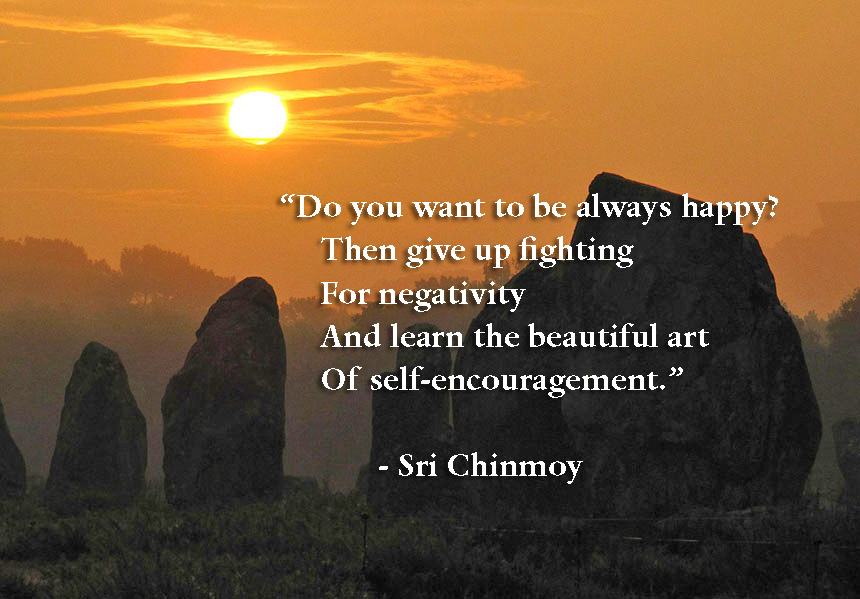
Do you want
To be happy,
Learn the beautiful art
Of self-encouragement.

- Sri Chinmoy

It is a fine balance between self encouragement and self-criticism. To honestly evaluate ourselves is a difficult task. We tend to either conveniently ignore our own faults or become too harsh on ourselves for small inconsequential things. We need a balance of self-encouragement and honest self-appraisal; getting the right balance is not so easy.

Tips for Self Criticism

Don’t Be Ashamed of your Faults.

If we can’t be honest with ourself who can we be honest with? The mind can be good at justifying our wrong actions and behaviour. But, clever self-justification is of no benefit in the long run. If we can be aware of our own pride, jealousy, insecurities then we have a chance to let go of them. But, if we always justify our wrong attitudes to ourself then we are lost.

Avoid Guilt
.

One of the reasons we may seek to ignore our faults is that we feel guilty. Rather than feeling guilty we avoid criticising ourself. However, it is better to be self-critical without feelings of guilt. Guilt is an emotion that doesn’t help but makes us feel more inadequate. Become aware of what you want to change and see it is a positive movement.

Not self-contempt
But self-improvement
Has to be
Our continuous choice.

- Sri Chinmoy

Don’t Judge By The Values of Others.

The biggest problem is that we start to judge ourselves by the standards of others. Our friends may have been put out because of something we did. Therefore, they try to make us feel guilty. Because others are critical of us, we feel obliged to feel guilty too. But, we have to be firm and reject others’ criticisms - if they are not justified. In the eyes of the world we may have done something wrong. But, only we know our inner attitude. We may have done something with the best of intentions and motivations, but, because of circumstances beyond our control, thing turn out badly. The world will criticise us, but, we know we did our best. How can we criticise ourselves for bad luck or circumstances beyond our control?

  • At the same time, we may get praise when we don’t deserve it.
  • Also, although we shouldn’t accept the misinformed critisims of others. We should be open to the suggestions of others. Often people can see things about ourselves that we can’t. Don’t be too proud to take advice / suggestions / criticism from others. It is not a sign of weakness to listen to other people. Our sincerity will know whether they are telling the truth or not.


Judge Motives rather than Outcome
.

As mentioned in the previous point it is our inner attitude which is important. A small action done selflessly without expectation of reward is worth more than egoistic selfish actions which may appear to have a better outcome. It is our inner attitude that we need to be aware of.

Remain Balanced.

When we start to criticise ourself it is easy to lose a sense of proportion and start beating ourselves up over a small issue.  This is a real mistake. We might make small mistakes but, making them into big problems just makes the situation worse. Never lose a sense of proportion and don’t magnify small problems. At the same time don’t be dismissive of actions that are causing pain to others.

Self Criticism and Self Encouragement.

Focusing on the negative doesn’t help. The most effective self-criticism is to also learn the art of self-encouragement. Be aware of the good selfless deeds and thoughts you have and give these more importance. If we strengthen our good qualities then this will take care of most of our weaknesses. The positive approach is by far the best way to help our self-improvement.

photo by Pavitrata

Related Posts

Values of Happiness

Recently, at a public lecture on the theme ‘blueprint for world peace’ I found myself sitting next to a very quiet African man  from Burundi. We both took a liking to each other and I gradually learned over the course of several subsequent encounters that he had been one of many refugee children, dispossessed by war and fleeing from murderous armies and tribal militias, that had been the subject of much media attention and outrage. Hounded and decimated by soldiers, killed by wild animals or dying of starvation, these many hundreds of children  had dwindled to only a handful of survivors and my new friend whispered of the terrible events that had filled his life and caused the death of his entire family.

Friendships bloom in the unlikeliest of manners and our life paths kept intersecting. On one amusing occasion I invited him to a hotel function that celebrated  a happy conclusion to a peace initiative I had been involved with. Nicholai had told me he would be a late arrival, and as his English language was not strong I promised to look out for him. After quite some time had passed I became concerned and began to look for him. Over in an adjacent huge ballroom, corporate types were hosting their own national get-together, a bacchanalian affair where hundreds of suited executives were dining, speech- making and almost climbing over each other to lay siege to a buffet table groaning under mountains of alluring food. A sudden possibility occurred and I scanned their ballroom from the open door – and sure enough there was our lost guest sitting merrily with a group of complete strangers, glass of champagne half-raised to his lips and blithely unaware that he had wandered in to the wrong function and invaded a Civil Engineers soiree. He looked so happy and I wondered whether I should leave him there with his whole new set of friends and dazzling new social possibilities. But I quietly retrieved him and brought him, both of us smiling at life’s vagaries, to our rather less glamorous function.

Nicholai’s heart-rending life had not made him forlorn or melancholy but filled him with gratitude and purpose and a resolve to offer all of himself back to the world to repay his own gift of life. All of the deaths he had seen had deepened him and awakened him spiritually…’death is as close as your breath’ he would tell me. He carried a battered copy of the Dhammapada, the Buddha’s teachings on impermanence, and would whisper to me solemnly : ‘Why are we born?  We are born so that we will not have to be born again’. He was speaking of the viewpoint that all life experience, if properly understood, offers us countless opportunities to learn equanimity and end suffering with it’s endless cycles of birth and rebirth.

How much joy we get in the company of those with whom we share an affinity of souls. Nicholai’s life had been stripped of everything that most people spend a lifetime accumulating – in return he had won the great spiritual treasures of desirelessness, simplicity, gratitude and spiritual awakening. He reminded me of a story I had heard from the life of Sri Krishna:

- stopping for a night at the simple cottage of a very poor devotee, whose only worldly possession was a cow, Krishna and his dear disciple Arjuna are treated with care and great kindness by the old lady who does not recognize who they are. In the morning Arjuna requests Krishna to reward their host for her selflessness and sacrifice and He agrees – he will take away the life of her cow! How can you be so cruel, asks Arjuna in dismay. Krishna replies, now she loves both me and her cow, but soon she will only have me and I will be the only thing left to her. She will rely solely on me, and in this way she will soon become one with me and live always in my heart. Then I will take care of her every need.

In our own quest for happiness we so often look to the impermanent and outer things of life – later we come to understand that happiness is not another person or place or circumstance or acquisition but a state of desirelessness, an inner achievement, a life of simplicity or devotion to God, the offering of oneself to a higher cause, egolessness and inner contentment. ‘Simplicity is an advanced course’ wrote my own teacher Sri Chinmoy. Indeed.

Nicholai’s wife died of gunshot wounds and whispered to him- ‘don’t be sad…go far away and start again…’ My own wife died of a lingering illness and I have only a last aphorism she wrote on a piece of paper, the handwriting spidery and wobbling with effort, a quotation by Sri Chinmoy: ‘Obstructions loom large, within, without. Yet, like a kite I shall rise without fail and fly against the wind’.

Death and sadness and loss teach us our life lessons and form an integral, indispensable part of our compassion for others and our own enlightenment. Nicholai makes me smile when he says to me: “I’m not sad any longer when someone dies – his suffering in this life is over. If you want to be sad, be sad when people are born: ’Oh, no, they’ve come again. They’re going to suffer and die again!’ “ He quotes the Thai master Ajanh Chah – “ we don’t meditate to see Heaven, but to end suffering”.

This is a guest post by Jogyata Dallas. Jogyata lives in Auckland, where he frequently gives meditation classes for the Sri Chinmoy Centre. see: Auckland Meditation

Related Posts

Photo by Unmesh Swanson, Sri Chinmoy Centre gallery

Changing yourself by accepting yourself

The very notion of ’self-improvement’ can often imply a deep dissatisfaction with ourselves and with life. This is rather unfortunate, because such an attitude can be pretty counterproductive if we want to change ourselves! Let’s first explain how accepting ourselves does not mean giving up on improving ourselves; in fact it makes the whole process of self improvement much more joyful:

  • We get to set our own standards for self-improvement: Often we are unhappy because we judge ourselves by some unrealistic standard, which has often to do the expectations set by other people and society. By accepting some external guideline for what constitutes self-improvement, you are in effect comparing yourself to others.  Accepting ourselves allows us to judge our self improvement not by criteria set by others, but by our own previous marks.
  • We get to focus on the positive: Often we spend so much time poring over our faults and failings that they occupy our entire mental space, leaving no room for us to appreciate our good qualities. By constantly ruminating on our weaknesses we give them a kind of power and we feel more and more helpless to overcome them. However by accepting yourself as you are, warts and all, you can then focus on increasing and expanding your good qualities - you will notice that your weaknesses will decrease in strength as well. Indeed, the most effective way of reducing your weaknesses is not by focusing on them, but by invoking its opposite positive quality instead.
  • We live in the moment: Self acceptance means accepting whatever you did in the past, no matter how deplorable, is done and there is nothing you can do to change it now. Any time and energy spent wondering what might have been is therefore pointless. You have to start from where you are, here and now, at your current state of development, with what you have at your disposal.
  • We change our attitude to the world: A poor self image leads to problems relating to other people, and excessive time wondering how others perceive us. However if we are happy in our own skin, then we begin caring less about what people think about us, and more time caring about people.

So how do we go about cultivating a philosophy of self acceptance? Here are a few tips:

  • Create space to acknowledge your good qualities. Our mind often seems automatically geared to think of only the bad about ourselves, you have to consciously shift the focus to the good.  Even a simple five minute daily exercise of writing down the good things you did (no matter how small), or positive thoughts and inspirations you have had helps enormously.
  • Don’t identify with the mind. We often see our minds as the final arbiter over our behaviour, and take anything it tells us very seriously, especially when it tells us something bad about ourselves. However a practice of meditation can help you access a deeper part of your nature, and take your thoughts much less seriously.
  • Compete with yourself rather than others. Whether it be work, sports or any other field of endeavour, try to set your challenges not so much as achieving a fixed goal or competing with others, but more about transcending your own personal best. This relieves the pressure of outside expectation, and you will get tremendous joy from knowing that you have gone beyond anything you have previously done.

Photo: Jowan Guthier, Sri Chinmoy Centre galleries

An even more unexpectedly powerful quality: Humility

Last week I wrote about gratitude, sharing my experience of how contrary to its associations with meekness, it can in fact be a form of unexpected power. Humility, if anything, is a quality that has even more of those mild saintly associations, leading us to think of doormats who turn the other cheek no matter what who is trampling all over them. And yet (surprise, surprise) nothing could be further than the truth, and here’s why….

First of all we need exactly to define what humility is. Because our ego often gives rise to excessive overpromotion, we feel that humility therefore involves the opposite extreme - publicly castigating ourselves and laying on excessive lashings of forced modesty. Yet the underlying feeling behind this kind of behaviour is insecurity and a desire to have others think better of us, and as such is just as much a manifestation of ego as excessive aggrandisement.

Humility is, quite simply, what happens when we go beyond the ego - a sincere and genuine self-appraisal, taking into account the entire being, all the faults and good points alike. As meditation teacher Sri Chinmoy points out “When you take a back seat consciously and deliberately in order to show others how humble you are, you are not being humble at all. True humility is something different; it is the feeling of oneness. Humility means giving joy to others. When we allow others to get joy, we feel our joy is more complete, more perfect, more divine.”

Continue reading →

The Difference between False Happiness and Real Happiness

mt rainer

It seems we are all striving for happiness; but, what do we actually mean by happiness? There is a big difference between a fleeting pleasure and an inner happiness independent of external events. These characteristics help to differentiate between real happiness and false happiness.

Peace and Happiness:

Real happiness brings inner peace. When we are sincerely happy we are at peace with the world and with our self.
A false happiness will be accompanied by insecurities, doubts and worries. We think our happiness could easily be spoilt by external events. To cultivate  happiness based on an inner peace it is necessary to be detached from the worries of the mind. We should not have a feeling of indispensability, but a calm acceptance of external events.

He is happiest, be he king or peasant, who finds peace in his home.

- Johann von Goethe

Pride.

A false happiness comes from a feeling of superiority. We feel that happiness depends on proving to the world that we are better or more indispensable than other people. A close relative of pride is jealousy of others whom we can not surpass. Real happiness takes joy in the achievement of others; in real happiness there is no feeling of inferiority and superiority, but only a sense of oneness. If you are constantly judging yourself against others, real happiness will remain elusive. If you can gain joy from others success, you have discovered a secret of real happiness.

Praise vs Detachment

If we are praised to the sky we are in the seventh heaven of delight; when we are mercilessly criticised we feel in the depths of hell. Relying on the praise of others can, at best, only give a fleeting happiness. Permanent happiness comes only when we maintain a sense of self esteem which is detached from the volatile opinions of the world.

To live a pure unselfish life, one must count nothing as one’s own in the midst of abundance.

- Buddha
Success vs Self Transcendence.

Success gives us a temporary feeling of euphoria; we have fulfilled our desires and now we can be happy. But, the joy of success is temporary and short lived. No success is permanent, and often we are often left with a desire for an even bigger and better success. Self transcendence is the ongoing process of self development and self improvement. The happiness of self improvement is not in achieving, but in the process of aiming for a better life. The joy of self transcendence is not confined to the odd victory, but, is the permanent journey of self discovery.

Continue reading →

The Art of Forgiveness

primrose hill

Forgiveness does not change the past, but it does enlarge the future.

- Paul Boese.

Forgiveness is a powerful way of moving on from unfortunate experiences; it is a way of illumining a darkened past. Without forgiveness we dwell on the negative attitudes of other people and the limitations of our own self. True, it is easier to talk about forgiveness than actually do it; but, if we can forgive, it is a powerful way to let go of negative experiences and make a fresh start.

Why We Need to Forgive

Hatred makes us feel miserable.

If we are unable to forgive and forget the misdeeds of others we will carry a heavy burden around ourselves. It may have some justifications, but, hating others means that we will make our own lives difficult. When we concentrate on the bad action of others, we give too much importance to these negative qualities and invariably they become part of our mindset.

We cannot live in the past forever

Forgiveness is a way to move forward. If we are unable to forgive we will always be thinking of the past. By thinking of past blunders we will not gain illumination. Forgiveness means we allow a new chapter to be written and prevent the old mistakes and difficulties being repeated.

Mistakes are inevitable

We cannot expect ourselves or other people to be perfect. Mistakes are an inevitable part of life. Even if people are trying to do their best, they may often behave with the wrong motives and actions. If we expect anything near perfection from others, then we will always be disappointed. To be forgiving means to be flexible, tolerant and accommodating.

To err is human.
But be careful,
Do not over do it.
If to forgive is divine,
Then rest assured,
You can never over do it.

- Sri Chinmoy

A person is more than certain actions

Often our judgement of a person depends on a particular action of theirs. When someone does something wrong, we inwardly label them as a bad person.This is a mistake; someone may have unfortunate habits or bad actions, but, this is only one aspect of that person. We would not want ourself to be judged on all our mistakes; we have done wrong things, but we know this is not the sum of our person. Forgiveness means we are able to separate a person from a bad action. We are not condoning the bad thing they do; it just means we acknowledge that anybody who does wrong things also has the capacity to do good things as well. Somebody may tell a lie, but that does not mean we have to think only of them as a bad person.
Continue reading →

Harnessing the power of self-giving

Flower from Bikash

One great theme which psychologists have sought to address over the last fifty years is why so much human energy is directed to serving the needs of others. From the millions of people who give their time and energy looking after kids sports teams or working with the homeless, to extraordinary tales of ordinary people sacrificing their lives for people they have never even met, there is an enormous amount of care and giving out there, sacrifices that often do not get due attention in a media preoccupied with negative stories. For psychologists, it can be very hard to reconcile this behaviour with the evolutionary principle that we are all individual agents in a battle for ’survival of the fittest’.

Giving comes from the heart

Undoubtedly, the notion that we are all looking out for ourselves and our progeny does indeed have some foundation in truth. There is no denying that there is an animal part of our nature which is still a considerable force to be reckoned with - the world is still rife with ’survival of the fittest’ behaviour, jostling for position, and looking out for number one. When we live in the mind, it is this kind of behaviour that takes prominence. The mind tends to cut us off from others’ hopes and feelings and induce feelings of ‘them’ and ‘us’, with all the feelings of superiority and stereotyping that come with that.

However, those of you who are frequent readers here at Sri Chinmoy Inspiration know that many of our posts are given to exploring a deeper part of our being beyond the mind. In the heart - that space in the middle of the chest where we can feel the core of our being - we have a part of ourselves that we often only connect with in moments of great beauty or silence, a part of ourselves that comes forward when the mind is still, and a place where all the best impulses of mankind are located - empathy, brotherly love, and oneness. We have the saying ‘my heart went out to him…’ and this is exactly what happens when we see someone in a state of distress; we instinctively empathise with his condition and and we can feel a part of us wanting to overcome the self-obsessed aspects of our nature and help. This is the root of all true self-giving. Continue reading →

Keeping Things in Perspective

sunset Hawaii

A sense of perspective is vital to keeping sane and avoid small problems that can unnecessarily overwhelm us. If we lose perspective we can end up worrying for hours about things that may never even happen. To keep things in perspective it is particularly important to live in the present moment and avoid being overwhelmed by fears and concerns about the future.

Here are some tips to keep things in a sense of perspective.

See Things from other people’s point of view.

This is something that can be quite difficult to do. When we feel aggrieved at a situation or person, try to place yourselves in their shoes and try to understand their motivations and actions. We don’t necessarily have to agree and sympathise with them. But, if we can really look at an issue from other people’s perspective we can sincerely understand a very different perspective on the issue. This will help us be more sympathetic in our judgement and response.

Does it matter what other people think?

If someone makes a critical judgement, don’t let it be the end of your world. Just because we have received some negative feedback, it doesn’t mean it is entirely true or that we should take it to heart. Criticism invariably results from some small mistake; and doesn’t reflect on our overall character.

Are You misjudging other people?

Sometimes problems occur because we wrongly assume other people are acting from a certain motivation. The mind suspects and assumes the worst, yet, often we are incorrect in our assumptions. If someone fails to acknowledge our presence or contribution; we should avoid making the jump to assuming that they therefore no longer like us. The mind can be very tricky - it can take a small incident and magnify it out of all proportion. It is important to be very careful in judging people’s motives, especially when we assume them to be negative. If we suspect the worst we lose something precious within us.

Does this cause any major problems?

Sometimes we can get worked up about problems that are very insignificant. Perhaps we like to keep things in a certain order, but our house companions fail to clean up. It’s a bit inconvenient if people leave dirty washing in the sink; but, at the same time it’s not the end of the world. Think about the things that have concerned you in the past few days; and be honest in questioning how important they really are.

Continue reading →

Real Happiness and the Heart

heart

Recently, I wrote an article for Pick the Brain - 6 characteristics of happiness.

John Wesley also wrote an interesting discussion about the meaning of happiness here.

I think in some ways, everyone is trying to aim for more happiness in life; sometimes people’s methods may seem strange but our decisions tend to be driven from what we think will be good for us. In a sense, everyone is trying in their own way to do the right thing. However, the problem is that what we think will bring happiness often doesn’t. Because it is so important, it is worth taking the time to think carefully what really brings happiness. We also need to have a willingness to challenge long cherished beliefs.

Since the age of 18, I have been a ’seeker’ consciously looking for what gives genuine happiness and satisfaction. I have pursued many different strategies, read many books and tried many things. From all these I feel that the most fruitful way to cultivate happiness is ‘to live in the heart’ As an academic and believer in the power of the mind, this hasn’t always been easy, but, these are some of the characteristics of living in the heart.

Continue reading →

How to be kind to yourself

lotus

We all know we should be kind to animals and considerate of other people. But, are we actually kind to ourself? If you regularly find that you are beating yourself up or are plagued by guilt, it is worth making an effort to be a bit kinder to yourself. Here are some ideas so that you offer a bit of support for your good self.

The Past is Dust

‘The Past is Dust’ is one of the favourite sayings of my Spiritual teacher, Sri Chinmoy.

“I always say the past is dust. By thinking of it and brooding over it we cannot change the past or free ourselves from guilt. If we have done something wrong, it is past. Let us think of the immediate future and allow it to grow into the immediacy of today.” [1]

When we live in the past, we become plagued by regrets and guilt. By constantly reliving the past, we cannot change what has gone before. If we have made mistakes in the past, we should not feel that this is our permanent reality. Focus instead, on the present moment and see how you can improve and go forward. It is only by focusing on the present and doing the right thing, that we can learn from the past.

Do One Thing at a Time

We have all tried to juggle several things at once. We also know how stressful and difficult this is. Sometimes when we try to do several things at once, we give ourselves an exaggerated feeling of self importance. However, don’t pile pressure on yourself; value simplicity and do one thing at a time. When you focus on only your current activity, you are not only being kind to yourself; but, also will be able to do things much more effectively.

Continue reading →