June 8th, 2009 — | Posted by Tejvan Pettinger | communication -

Smiling helps any conversation
Sometimes silence is a much underrated quality but, everything has its time and place. Good communication is essential for dealing with others.
These are some tips for better communication.
Tips for Speech / Conversation.
Avoid unnecessary words.
We peppar our speech with unnecessary words. “you know some people say….” I mean…” Sometimes less is more, these extra words can also sound condescending. Speak plainly.
Speak clearly.
There is nothing more frustrating than a conversation which is half heard. Always try to speak clearly. If someone asks you to repeat yourself once, make a special effort, because often people will not ask more than once out of a sense of embarrassment.
Be wary of speaking harshly.
If you are really disappointed with someone, you can express your disappointment / frustration without anger / bitterness. The other person will be much more receptive to your message delivered with sweetness - - or at least the absence of anger and disgust. Sometimes it is more beneficial to take the compassionate approach rather than the justice approach. People may deserve a harsh lesson, but, would it actually help?
Avoiding unnecessary communication.
It is good to communicate well, but, you can have too much of a good thing. Don’t bombard friends with unnecessary text messages. Be confident in your friendship rather than looking for constant reassurance.
Method of Communication
In a digital age, we tend to gravitate towards the most convenient communication. But, the most convenient communication can be the least personal and least effective. An electronic message has much greater scope for misinterpretation and misunderstanding than speaking to someone in person. The next time you say something satirical / sarcastic to a friend try imagine sending that message in an email. You can guarantee without the benefit of facial expression / human contact the message would be misinterpreted.
Difficult Communication.
There are many times when we want to say something, but, put it off because of - nervousness, a desire to avoid difficult situations, or a feeling of guilt for having to tell someone off. But, putting off communication often just makes it worse. What tends to happen is that when we put off speaking to someone our mind just magnifies the problems, turning a small issue into a big problem. Our mind speculates on many adverse reactions which are false. If we find ourself in this situation, the best thing is to speak sooner rather than later.
Suggestions for Difficult Communication
- Let go of negative expectations - they will probably be wrong anyway.
- Just speak with kind intentions. If you have the other persons best wishes at heart, then whatever you have to say will be easier to say. Also, if you have good will towards the other person, then you can easily let go of all guilt that may be blocking you from speaking to that person.
- Remember the positive things that will occur from bringing up difficult situations. The other person may appreciate your intervention at some time - even if not now.
- Let go of a feeling of pride. Don’t feel the conversation is about having to defend yourself, prove yourself and put the other person down. This kind of attitude is guaranteed to create an awkward situation. Be self-giving and give no importance to silly human pride.
It’s not what you Say, but how you Say it.
Suppose you have to tell someone they have been doing something wrong. There are two approaches. The first is to exaggerate the extent of their mistake and try to make them feel guilty for doing such a silly thing. The other approach is to start off by saying it is the kind of mistake you could have made yourself. Even if you say a white lie and say you once did the same thing, who will be hurt?
If you think about both approaches, you will know exactly how you would want to be treated should someone tell about your misdemeanours.
Give the person your undivided attention.
It may seem obvious, but, often when we are speaking we are subconsciously thinking of something else. I have even skyped someone and during the conversation I heard them typing away in the background. If you are going to speak to someone give that person your wholehearted attention.
May 18th, 2009 — | Posted by Tejvan Pettinger | life -

Enthusiasm and motivation are key principles for getting anything done. If we are motivated and committed we find ways to get round obstacles. If we lack motivation then we easily find difficulties and excuses to give up. To increase our motivation we really need to be clear what we want to do.
These are some tips to Increase Your Motivation
Be Clear What You Wish to Achieve
It is important to know what is important to you. Think carefully about what really matters. If you consciously give something a high priority, then this is half the battle for gaining motivation. We often struggle to gain motivation for an activity / issue because we are not clear in our mind about what we wish to achieve.
- For example, we may go through life with a vague idea it would be good to get up earlier in the morning, but, only if we really see benefits will we have motivation
Just Act!
We can only be fully committed to a certain number of things; we need to prioritise what is important. However, whilst it is important to be aware of life’s priorities, we don’t want to spend too long just thinking. If we sit around planning and thinking, the mind will find innumerable problems and complications which reduce our motivation. The best thing is to get started and through yourself wholeheartedly into a project. Once you get started and focus on a project it develops a certain energy which is self reinforcing.
I teach Economics and many of my students say how worried about the exams they are and how they haven’t time. But, their real problem is just to get started with work and revision. The worst is just sitting around saying how little time they have.
Don’t Rely on External Praise
Often we lack motivation because we feel our efforts are not fully recognised. To be willing to work without praise is a real boon. The secret is to feel the satisfaction from doing the right thing and giving ourselves the opportunity for our self-improvement. We shouldn’t just be motivated for the end result, but, for the challenge of getting there. Be kind to yourself and notice the satisfaction you gain from doing the right thing in the right attitude, this will always be worth more than the fleeting praise of others.
Satisfaction.
Lasting motivation will come when we get joy from doing something. The problem is we often feel worthwhile changes of projects require self-discipline, sacrifice and difficulties. It is this which discourages and de-motivates. We need to change our attitude, rather than thinking of the sacrifice or discipline we need to undergo, focus on the lasting sense of achievement we get.
Remove Distractions
To increase our motivation to do something useful, we often need to avoid the distractions that pull us away into insignificant things. After sitting in front of the TV for one hour flicking through channels or surfing useless internet sites, it is remarkable how much motivation can disappear!
Be of Service
If we just think of ourself then it is hard to do difficult things. However, if we really try to emphasise with others then it is much easier to be motivated to make difficult changes. See: Helping an alcoholic.
Understand Costs and Benefits
We have a tendency to stumble from one crisis to the next. If we get stomach pains we reach for the stomach pills rather than looking at our diet. Often we need motivation for activities where benefits are long term and costs are short term. But, looking after our health, for example, will give much benefit in the long term. We just need to remind ourselves of the costs and benefits.
Look After Your Energy and Health
A fit body is very helpful for any change we wish to make. See: How to Cope with low energy levels
Related Posts
Photo from World Harmony Run site
May 11th, 2009 — | Posted by Tejvan Pettinger | life -

There are many things that we aspire to do, but, for some reason they remain quite difficult. It is better to have the right intention and be aware of how difficult they are. These are some of the things that are very difficult to do and how we could make them a little more practical.
Admit We’re Wrong
Nearly all of us find it difficult to admit we were wrong. It stems from a false belief that we somehow always expect ourselves to be right. Part of the problem is our pride. We feel embarrassed to admit we get things wrong; we feel it somehow diminishes our own standing. But, to admit we were wrong is a sign of strength, flexibility and humility. People will never think ill of us simply because we admit to making a mistake. The mind’s insistence on trying to justify everything we do merely creates problems for ourselves and others. We need to change our mindset and be happy to admit to mistakes without feelings of guilt or humbled pride.
“Why do we find it so difficult to confess our mistake’s? The immediate answer is fear. What is fear? Fear is something that constantly binds us. Fear is something that constantly tells us that we are entirely different or separate from others, that our existence is only for ourselves.”
- Sri Chinmoy
Be Non Judgemental
We come across many people in life. Some we like, some we develop dislike. Our mind is constantly judging. We judge people on their appearance, on what they say. Then our interactions with them are clouded by our judgement. It is much better to have a clear mind without prejudging others.
Accept Criticism in Good Spirit
Criticism can be an excellent opportunity to learn and develop. Without criticism we may continue to make mistakes and gain a large ego. Yet, despite the benefits of receiving constructive criticism. We feel challenged and personally affronted. We love to receive praise but struggle to deal with criticism.
Be Cheerful under all Circumstances
Life gives us ups and downs, whether we like it or not. There is nothing we can do about our circumstances. Sometimes fate gives us challenging circumstances. Becoming miserable does not help, it only makes the situation more difficult. To remain cheerful in difficult circumstances is a great boon. Cheerfulness can overcome many obstacles and help us to discover light even in seemingly difficult times. But, unfortunately, when things don’t go to plan we start feeling sorry for ourselves and glum. Of course, this does not help; but, this is what we tend to do.
Practise what we Preach
Alas, it is easy to say what we should do, but, it is another thing to do it! If world peace could be attained by good intentions it would be achieved a long time ago. Quite often we know what we should do, we hear our voice of conscience or message from our heart, but, some other force prevents us from doing the right thing.
Even worse, we tell others what to do - when we have no intention of doing it ourselves. Still to have good intentions is a start. What we need to do is talk a little less and act a little more. Putting into effect our good intentions is the real challenge.
Listen
Everyone wants to talk, but, how many have time to listen? Listening is a great art. Just listening to others can help them to work out their problems. They don’t need our advice, but, they may need an opportunity to work out what they should do. If you dominate conversations and always like to have the last word. Sit back and try to listen, especially to those who are shy or need a reliable friend (see: The art of listening)
Do One Thing at a Time
Simplicity and focus is a great virtue. But, we feel if we can try to do 2 things at once we will get more done. Alas, this rarely works, we just get stressed from the demands we place on ourselves; stress that need not be there.
Get Up early in the morning
How beautiful it is to get up at dawn, listening to the dawn chorus before the rush of humanity enters the day. Unfortunately, the body doesn’t always follow our own good intentions. Though you could try these tips to get up early in the morning.
Eat Less Sugar
Another good habit would be to eat less sugar. But, cake tastes good so what can we do?
May 5th, 2009 — | Posted by Tejvan Pettinger | life -

Nobody really likes getting older. But, to think of ageing purely as a physical process is to miss the importance of our mental outlook. If we want we can easily remain young at heart - whatever our age.
Sometimes we see someone in his twenties and already he is grumbling like an old man. But, at the same time we see someone in their 70s and they have the life and attitude of a young child. To remain young at heart and forgetful of our outer age is a real blessing which enables us to enjoy life whatever our advancing age may be.
Secrets to Remaining Young at heart
Spend Time With Children.
Children enjoy life from the heart. To see a child’s smile uplifts even the hardest heart. If we spend time with serious old people we will feel a serious old person too.
Don’t Identify your Self with Your Physical Age.
Everyday we look in the mirror and gain the habit of identifying our sense of self with the body. Thus when we see grey hairs and rinkles appearing we feel older - because our body is becoming older. But to remain young in heart and mind, our physical appearance is an irrelevance. We need to break the link between our physical condition and state of mind. We try to keep the body healthy. But, our sense of self should never be dictated by the number of summers this body has seen.
Be Spontaneous.
A childlike attitude is spontaneous and free. A child can take joy in simple things because it is not mentally creating a 5 year plan to buy a new TV. Try to listen to your heart and do things which give you innocent pleasure. Spend less time thinking and more time living in the present moment.
Don’t Spend Time Picking Faults
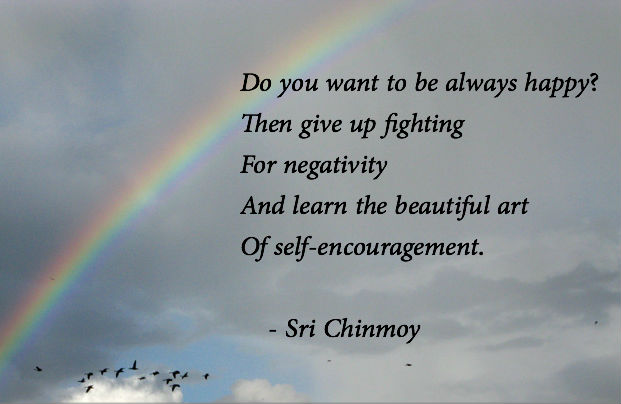
When we criticise others,
We do not go forward.
We just go backward,
To our greatest shock.
- Sri Chinmoy
It is complaining and grumbling which really gives us a feeling of being old and weary. Unfortunately, as we get older we get into a mental habit of finding fault and criticising the innumerable problems of the world. It is this tendency to be critical which really gives us an ageing outlook. A critical attitude has an impact upon ourselves. It is we who become negative, yet, of course, our criticisms never improve the world.
Be Active
If we are active we don’t have time to get depressed about our old age. Compete with yourself and not others and get joy from transcending your own goals.
Stop Being Guilt of Your Age
I know many people close to me, who really feel bad if you ask them how old they are. They tell their age with such reluctance - as if they had just been diagnosed with some serious illness. Be proud to have more experience and more years under your belt. Becoming older in age is nothing to feel bad about.
April 27th, 2009 — | Posted by Tejvan Pettinger | life -

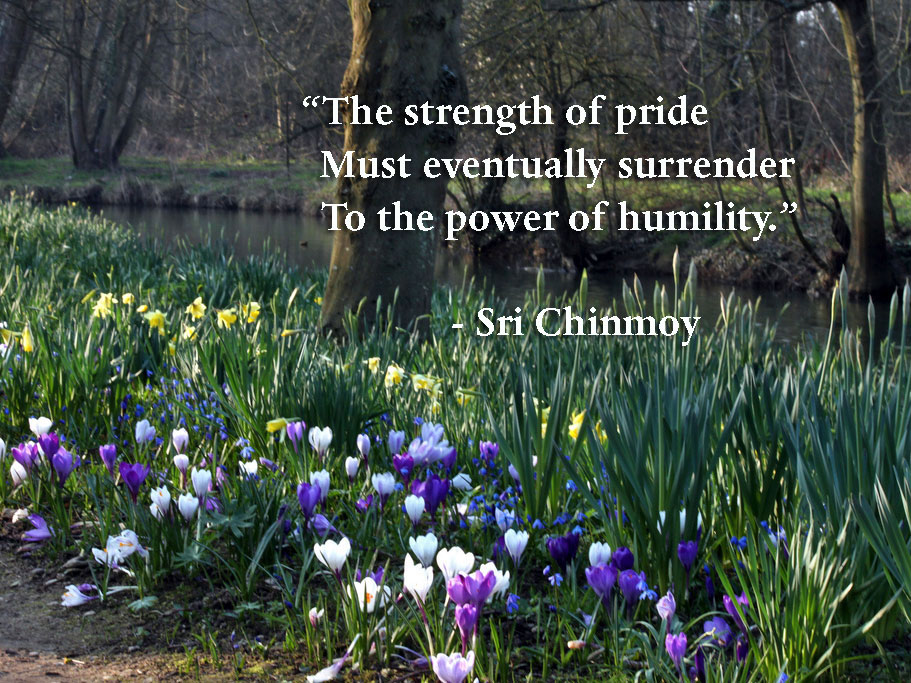
The old saying ‘pride comes before a fall’ is no idle old wives tale. It is pride that creates innumerable problems for both ourselves and the rest of the world. Yet, like the proverbial camel unable to stop eating thorns, it is our pride that enslaves us to continuing doing the wrong thing or creating unnecessary unhappiness.
Inflexibility
Our pride can create inflexibility. Because of our pride we are not able to change our mind, but instead we stick on a wrong course of action. We may know our initial decision is wrong, but, because of our pride we are unable or unwilling to back down and take a different course of action. We mistake this stubborness for strength, but actually it is a weakness because we are just unable to take a better course of action.
Always To Be Right.
If we have tremendous pride we don’t like to be proved wrong. This can cause us to justify wrong actions to ourselves. We may even come to believe that they are justified. But, we will spend an inordinate amount of energy in proving to others or ourselves we are right.
Aloofness.
Pride makes us feel aloof and self-sufficient. We feel we can cope without the support, guidance or help of others. We may even try to do things by ourself so that we can claim all the glory for ourselves. But, when we take this solo approach we limit ourselves and create unnecessary difficulties and limitations. John Donne said ‘no man is an island’ But, our pride likes to make us think that we can be a unique person.
Insecurity.
If our self worth is dependent on a sense of pride we become insecure and sensitive to the criticisms of others. Our pride requires constant support and constant bolstering. Pride can consciously or unconsciously encourage us to go fishing for complements. Our pride deeply enjoys flattery but cannot cope with criticism.
Unhappiness.
As Thomas Jefferson said:
“Pride costs more than hunger, thirst and cold.”
Pride invariable creates unhappiness. The feeling of pride is a false happiness. We get a temporary relief from achieving and being thought well of. But, this is unsustainable. Life throws slings and arrows whether we like it or not. Rather than trying to please the false ego we need to be at peace with ourselves whatever the circumstances.
False Modesty.
A more subtle pride is a false modesty - an extreme self depreciation. Pride usually makes us feel we are extra special, really excellent. But, at other times it is our pride which makes us feel guilty and useless. Because we fail to live upto expectations or fail to achieve something, we feel personally a failure.
Alternative to Pride
The alternative to pride is an inner humility. We don’t make a display of our humility (as this can ironically create a sense of pride in how humble we are trying to be). However, if we give little importance to pride we will be able to:
- Benefit from the support and advice of others when it is helpful. At the same time, we will not be thrown by unfair criticism.
- We will get joy from the achievements of others.
- We will gain happiness from our progress and attempt and not just when we succeed.
- We will be able to admit mistakes without feeling guilty.
- We have much greater flexibility and will be much more easy to get on with. It is pride that it is the biggest obstacle in developing good relationships.
- We will value harmony more than being ‘Right’
Related
Photo by Tejvan, Sri Chinmoy Centre galleries.
April 20th, 2009 — | Posted by Tejvan Pettinger | life -

During the past two weeks I have been in New York for a spiritual holiday. It was an opportunity to meditate and live away from usual distractions and necessities of daily life. It was a good experience to take a break, but, the writing muse deserted me, and time flew past.
We will be resuming our normal posting schedule soon. But, just in brief it is a good reminder that experiencing a totally different situation can help. Sometimes we need a change of scene and people to break old habits and gain different perspectives.
A strong part of human nature is a creature of habit. We go through the same routine, habits and even same thoughts. But, when we are forced to try new things and move out of comfort zone we often realise that our old habits are limiting and there is much more to life.
In particular, I felt no inspiration for spending time on a computer. But, now I’m back in the UK I want to get back into writing.
Related
picture: Pavitrata
March 30th, 2009 — | Posted by Tejvan Pettinger | inner peace -

The modern world with its many fascinations, distractions and temptations can give us many things, but the humblest of all goals - our own inner peace - seems the one illusive thing beyond our reach. Yet, to attain inner peace it is not necessary to go back in time or visit the timeless Himalayan caves. Peace is perfectly compatible with modern life, if we learn how to harness the values of peace to the dynamism of modern life.
Peace In the Stress of Life
Often I hear people say ‘I don’t have time to develop peace’. They have a vague idea peace may be gained if only they could win the lottery and retire from work. It is a misconception that inner peace needs to be associated with an inactive life. We can often find inner peace through a purposeful life, a life of serving others. If we wallow in our own lethargy, we will never cultivate inner peace. Inner peace we don’t get from watching TV, at best it may give us a slight sense of relaxation, but not an abiding sense of satisfaction. Inner peace comes from a feeling of living a purposeful life. If we are unhappy, we will not gain peace.
Doing Our Best.
We put ourselves under great pressure. We want to try and keep everyone happy. But, inevitably it is impossible to keep everyone happy and always succeed in doing well. We have to judge ourselves on our motives and intentions - not the external outcome or what other people think. If we work with the right attitude, doing the best in difficult circumstances - what else can we do? Don’t allow the unreasonable expectations of others to disturb your inner peace. If we can work with this sense of detachment then we will avoid many feelings of guilty, worry and anxiety. It is these forces that disturb own inner peace.
Inner peace can never be dependent upon outer success and outer praise. It is the nature of the world to give success / failure, praise / blame in equal measure. We have to transcend this at be at peace with ourselves whatever happens.
One of the great spiritual texts - The Bhagavad Gita, was given in the middle of a war (Battle of Kurushetra). Sri Krishna advised Arjuna:
Do your duty to the best of your ability, O Arjuna,
With your mind attached to the Lord,
Abandoning (worry and) attachment to the results,
And remaining calm in both success and failure.
The Bhagavad Gita, Chapter 2.
Simplify.
It is true we don’t need to live in austerity or a Himalayan cave to cultivate inner peace. But, it is equally true, that we can easily minimise the pressures and inconsequential distractions that are readily available in modern life. Modern technology has given us unprecedented access to technology and communication. Undoutedely this has benefits if used wisely. But, sometimes it is like getting a glass of water standing under the Niagra falls. In other words we can become overwhelmed with information and this can become almost addictive. Similarly we can spend hours sending short messages or doing small things. We become reluctant to switch off from the electronic world and spend time enjoying the simpler pressures of life.
There are many ways to simplify our life (see: 10 ways to simplify your life) . - Getting rid of junk, spending less time on checking email, taking time to ourselves; but this simplicity is often feared in modern society because we have become so used to absorbing out attention in external distractions. We need to disentangle from some of these to be able to cultivate peace.
Thoughts.
To gain inner peace, we must learn to control our thoughts. It is our own thoughts which can take us to heaven or hell - no matter where we are on earth. We have to reject thoughts of jealousy, pride and insecurity. If we, even subconsciously, cherish these emotions then peace will be a far cry. It is when we cultivate good / uplifting thoughts that we can avoid the mental disturbance that is so harmful to inner peace.(How to control thoughts)
Another issues which is always very important is the idea that we have to want inner peace - it is only when we truly value the life of peace that we will work to make it happen. If we don’t value inner peace - how can we expect to have a peaceful life?
Real Peace
If we avoid negative thoughts and negative emotions; if we simplify our life and take a compassionate attitude to ourselves and others, we will definitely have a more peaceful life. But, to experience a very deep and abiding sense of peace, we need to go beyond the thought world and awaken the silence within.
“To come back to the secret of inner peace, our questioning and doubting mind is always wanting in peace. Our loving and dedicated heart is always flooded with inner peace. If our mind has all the questions, then our heart has all the answers.
- Sri Chinmoy
It is this quiet part of ourselves, that is the real secret of inner peace. We cannot experience this silent peace, through philosophy or talking. It can only be brought to the fore by a silent mind and open heart. In concentration and meditation, we learn to silence the endless stream of thought and awaken this peaceful consciousness.
We might gain a glimpse of this kind of peace when we are lost in the marvels of nature or listening to the most profound music. But, to gain an easy access to the real inner peace, meditation is by far the most effective strategy.
Introduction to meditation
It is all in the Mind.
There was a great sage who spent many years meditating in a cave. Over the years he developed tremendous inner peace through his meditation. Once a great King came to visit and spoke to the sage about the turmoils of his earthly kingdom. The sage asked the King why not come and meditate with me in the cave - Then you can have peace. The king replied - what would the use be? If I came here, I would still be thinking of my Kingdom - I would be building imaginary castles in the sky. The King, at least, realised the route to peace lay in his mind and no where else.
There is another story about the great King Janaka who lived in ancient India. He ruled over a large Kingdom but was detached from his own world wealth and power. Once he was sitting with his Guru and several followers. When news came of severe weather, everyone rushed back to look after their possessions. But, King Janaka who had by far the most possessions remained unmoved. He was untouched by worry over his material possessions. He preferred to sit at the feet of his Guru. We may only have a few dollars in our pocket, but, if we spend all our time worrying about our material possessions we will not have inner peace.
Photo by Tejvan
March 23rd, 2009 — | Posted by Tejvan Pettinger | self improvement -

One of the biggest problems we have is the tendency for our mind to think in an irrational / unbalanced way. We see issues and other people through a clouded and fuzzy perspective. This judgement leads us to many problems, not least it makes life more stressful and depressing.
These are some of the common perspectives on life which are misleading.
Jumping to Conclusions
Often we jump to conclusions on a small fraction of evidence. Perhaps someone does not reply to our message at a particular point in time, we then project our own thoughts as to why this is. The mind creates a powerful scenario which we come to believe. Yet, our mental projections are often far from reality. To make things worse we often jump to conclusions in a negative way. The mind is suspicious of others’ intentions and we definitely create problems for ourselves by doubting our friends and relatives. We have to be very wary of jumping to conclusions; at the very least we should remind ourself our conclusion is likely to be wrong.
It may be unfortunate to be mistreated by others, but, it is much worse to have a suspicious mind
Black and White Thinking
We often come to see the world in black and white terms - either we are a total success or failure. Other people are either friends or enemies. The problem is that one small mistake can make us feel a total failure. For example, we say one wrong thing so then assume we have messed up a relationship with someone. On the other hand a small success can bloat us with pride. Life is never so clear cut; we have to avoid both the depths of despair and heights of vainglory. Rather than seeing ourselves as a total failure just see mistakes as stepping stones on the path to self-development.
Blaming other People for own Faults.
Often we sit in judgement on other people, but, if we were honest we would realise many of their faults we too share. We are not judging out of compassion but out of a sense of self-importance. The worst thing is when we do something wrong but seek to pass the blame onto other people - If only other people had done the right thing we would been fine. This is just our clever mind justify its wrong actions. But, with this attitude we will just continue doing the wrong thing and create more problems. We have to be honest with ourselves.
Over Dramatisation
Part of us likes drama and intrigue. We get a subtle pleasure from the soap opera of life. But, there is a danger in over dramatising situations where it is not necessary; we can feed negative situations and make small conflicts escalate beyond all proportion. We stake too much on an insignificant issues, often putting others on the spot to make decisions one way or the other.
Don’t take everything to heart - small issues will soon blow over - if we allow it.
Emotional thinking.
Emotions are fleeting. Anger comes and goes. Fear comes and goes. Our emotional state is unreliable guide to the truth of an issue. Many times we are relieved we don’t act out of impulsive anger. To really understand a situation, we have to see it without the cloud of emotion. Take time to see beyond a misleading emotion.
These ways of looking at life all share a common theme - it is easy to gain an unbalanced look at life. When we look at problems through a certain filter it is inevitable that we create problems and have poor perception.
To deal with this problem we need to avoid jumping to conclusions and be wary of our initial judgements. Before acting we need to test our state of mind
- Are we judging with our critical mind or our compassionate heart?
- How would we want over people to behave / think in our situation?
- If we spoke out aloud our thoughts would we be embarrassed about what we are saying?
- Have we taken a second opinion from other people we trust?
- Why are we being determined to see the negative side of life?
Related
March 16th, 2009 — | Posted by Tejvan Pettinger | productivity -

There is an old saying “If you want something done, ask a busy person. ” There is a lot of truth in this. Sometimes, we struggle to do anything productive - even if we have time on our hands. But, at other times we can do alot because we prepare, are focused and do it with enthusiasm.
There are several small things that can make a big difference to how successful we become. These are some tips to help get things done.
Be Clear What you Want to do.
It might seem a rather obvious point, but if we are not clear what we want to do - how can we do it effectively? I have a student who always talks of giving up smoking. Half of him wants to stop, but the other half enjoys it. If you want to do something difficult like give up smoking you have to be 100% committed. If you do something but are holding onto reservations, you will not be fully committed and so it will be much harder, if not impossible. Too often we drift along with vague ideas we should be doing something; we hold a certain guilt for not doing it, but, we fail to clearly resolve to take action - so it gets left on the back burner.
Clear Out the Junk.
One of the biggest obstacles to being productive is getting distracted by small silly things. Having a tidy / clear workspace makes a big difference to being able to work with great focus. Entering a clear, simple work environment gives a definite subconscious psychological boost. Just try tidying your workspace, ruthless clearing out the junk and pieces of paper - you will definitely notice the difference. We have a rather romantic view of the eccentric genius working in paper strewn mess coming up with complex equations. But, for most of us, working in this kind of environment makes it much more difficult to do anything. Investing 10 minutes to create a clear workspace is a good investment of time.
Do One Thing at A Time
It is not possible to do more than one thing at a time and be focused. Our attention gets split and we struggle to do either effectively. This doesn’t just mean physically doing only one thing at a time; it also means having our thoughts focused on one particular task. When writing an essay, we need to ignore other thoughts of what we will be doing tomorrow. There is no benefit in worrying over things that we have no control.
Be in the Right Environment
As we have mentioned in previous points, the real secret for getting things done is being 100% committed and focused. Another thing that can help is getting into the right environment. For example, if you need to work at home, create a suitable space for your work. If you carry your laptop into the lounge in front of the TV, you can get easily distracted. Even changing clothes can make a difference. Sometimes, I wander out into the garden in my slippers and start half-heartedly gardening. When you do something be in the right space, environment and with the right tools / equipment.
Prioritise
The art of getting things done doesn’t mean we have to be a permanent hive of activity, business and stress. The problem is that we are often ‘busy’ doing unimportant and inconsequential things. We need to make a list (either written or mental) of what needs doing and doing the most pressing things first, even if it is not necessarily the most pleasant.
Feel that whatever you do there is an opportunity cost. If we spend time flicking through tv channels it means we don’t have time for something more fulfilling and worthwhile.
Finish what you start.
The hardest thing with getting things done is often just getting started. It takes a mental effort to get started, so once we overcome this barrier try finishing it in one go. If we keep stopping and starting we will waste precious time and loose focus. Where possible try to benefit from economies of scale. e.g. rather than checking emails several times throughout the day, set aside one or two times to answer and deal with your inbox. This is more efficient than responding piecemeal to incoming messages. (and often when you are trying to do something else as well.)
Read the Instruction manual
It’s a bit of novelty in our ipod generation, but so many times I try to do something without any preparation, make it worse and then have to go back to read the instruction manual. Good preparation can save a lot of heartache and wasted effort. Jumping straight in without any clear plan isn’t usually the best way to get something done.
Be Enthusiastic for what you do.
If we can always maintain enthusiasm for what we do, our enthusiasm will carry us through all obstacles and problems. This is a real secret of getting things done.
photo by Prabhakar, Sri Chinmoy Centre Galleries
Related
March 12th, 2009 — | Posted by Tejvan Pettinger | meditation -

Readers Question: Can you recommend some meditation music you mentioned in this post Introduction to Meditation
These links will help provide some inspirational music for meditation
Other Links of Meditation Music
Using Music For Meditation
I often use music whilst meditating. It has to be music composed and performed in a meditative consciousness. It is not the music that excites and stimulates, but the music that inspires us to dive deep within.
Music can be useful if you meditate in a noisy environment (e.g. student flat) The right kind of music can also help still the mind.
The power of soulful / spiritual / meditative music is that it has the capacity to awaken our inner aspiration. It is this inner cry that is the most important aspect of meditation.
Meditation and music is quite a personal choice, but it is well worth exploring.
Related