Entries Tagged 'Music' ↓
March 19th, 2010 — Music

One Thousand Lotus Petals is a special recording of singing performances recorded by Sri Chinmoy in October 1999.
They feature some of Sri Chinmoy’s best known Bengali songs.
~
You want to know what I am doing.
I am just singing and playing
And playing and singing
In my soul’s universal nest.
January 12th, 2010 — Music
The Songs of the Soul concert tour began 2010 with three enthusiastically received concerts in Guatemala.

Songs of the Soul began in 2008 as a way to celebrate and introduce people to Sri Chinmoy’s musical legacy. The concerts feature Sri Chinmoy’s music played in different styles by many different groups, from instrumental duets to huge 100-member orchestras. In 2009, 19 such concerts were performed across 3 continents.
The first Guatemalan concert was performed in Panajachel overlooking beautiful Lake Atitlan. The second concert took place in Guatemala city.

The last concert was an outdoor performance in front Hermita de Santa Cruz in the ancient colonial town of Antigua. Much of the town was destroyed in earthquakes in 1773, leaving many impressive ruined structures behind. Around the building there is an outdoor amphitheater which seated 600 people for the concert.

More from songsofthesoul.com:
December 22nd, 2009 — Music
On 13 December in Dhaka, Bangladesh, a historic concert – Songs of the Soul – celebrated the music of Sri Chinmoy and Rabindranath Tagore, two of the greatest Bangla composers.

The music was performed by Ghandava Loka and Shurer Dhara who performed a mixture of music by Sri Chinmoy and Rabindranath Tagore, to an audience of 1,800 at Bangabandhu International Convention Centre (BICC.

About Dhaka Songs of the Soul
Photos of Concert
Review at Daily Star
December 14th, 2009 — Music
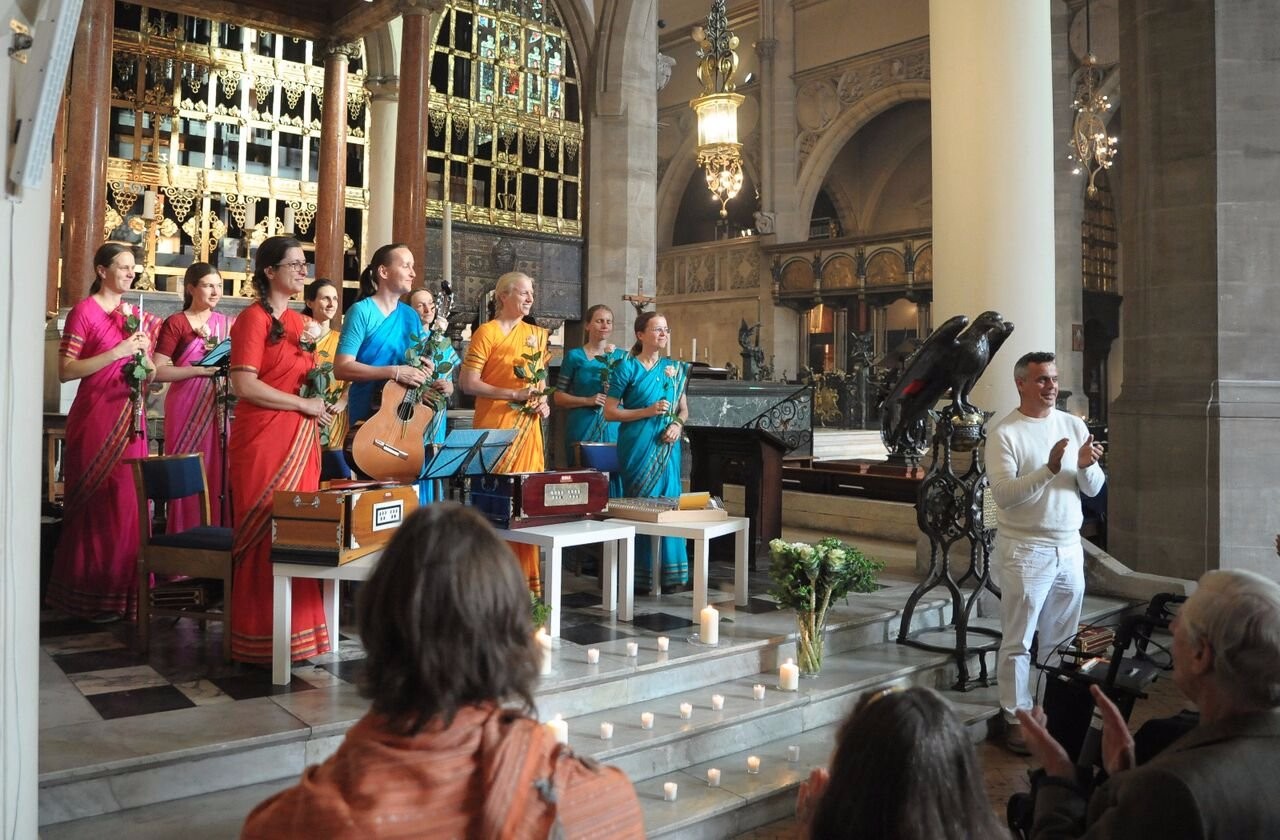
Shindhu are a female group of musicians based in the UK, studying the art of meditation under the guidance of Sri Chinmoy.

The group is led by Udasina Hansford who studied piano and classical guitar at the Royal Academy of Music. The group comprises members from 14 different countries – a few are professional musicians but most are just women who have discovered their love of music and capacity for singing through the music of Sri Chinmoy

Shindhu on Tour in Scandanavia
They have produced a range of music recordings that can be heard at Radio Sri Chinmoy.
See: Shindhu at Radio Sri Chinmoy
September 21st, 2009 — Music
In August, students of Sri Chinmoy meet in New York for the birthday celebrations of Sri Chinmoy. At these gatherings groups of students perform spiritual music composed by Sri Chinmoy.
This is a selection of music from these gatherings.
Music From August Celebrations Part 2
Music From August Celebrations Part 1
July 4th, 2008 — Music

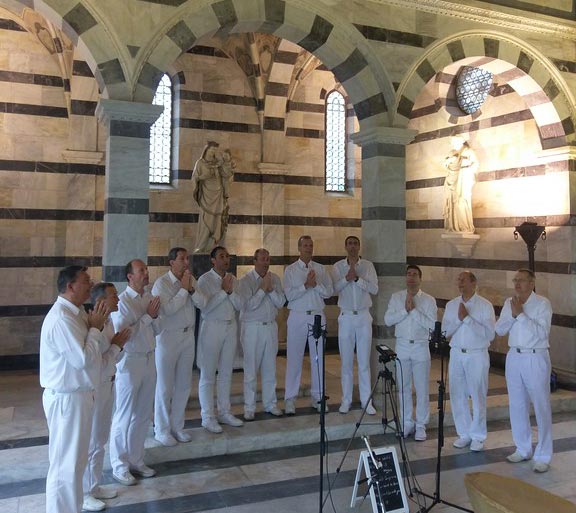
Temple Song Hearts are an international group of musicians who perform the music of Sri Chinmoy. Founded in 1998, they have offered concerts in many cities throughout Europe.
You can visit their new website here – Temple Song Hearts
Photos French Tour

Article on Temple Song Hearts concert in France
Photos from French Tour at Sri Chinmoy Centre
September 30th, 2007 — Music

Music plays an indispensable role in the spiritual quest of Sri Chinmoy’s students. “When we listen to soulful music, or when we ourselves play soulful music, immediately our inner existence climbs up high, higher, highest”, explains Sri Chinmoy in his book ‘God the Supreme Musician’. “It climbs up and enters into something beyond. This Beyond is constantly trying to help us, guide us, mould us and shape us into our true transcendental image, our true divinity. When we hear soulful music, or when we play a soulful piece of music, we feel a kind of inner thrill in our entire existence, from the soles of our feet to the crown of our head. A river is flowing through us, a river of consciousness, and this consciousness is all the time illumined.”
Meditation functions with Sri Chinmoy will often have a diverse range of musical performances: there are some groups and singers which will perform every week. In addition, when Sri Chinmoy’s students from all around the world visit him in New York in April and August, there will be performances from every country as well as instrumental performances from Sri Chinmoy’s outstanding musician-students from all corners of the globe.
On Radio Sri Chinmoy, 44 tracks have just been posted which nicely capture the flavour and diverse nature of these performances. The tracks were recorded between June and September 2007, with the majority of the tracks recorded in August when many international groups performed. The performances are mostly arrangements of Sri Chinmoy’s songs, but there is also performances of songs by the immortal Rabindranath Tagore sung by Rintu Chakravarty and some traditional baoul singing by brothers Ranjit and Unmesh Swanson. For these tracks we are very grateful to Kamalakanta Nieves, who edits radiosrichinmoy.org and is responsible for the recording of many of the tracks, and Sumangali Morhall, the webmaster of Radio Sri Chinmoy. You can listen to the music tracks here…
September 3rd, 2007 — Concerts, Music

Listen To Concert at Radio Sri Chinmoy
On 29 August 2007, the United Nations headquarters played host to a concert by an artist whose striving for inner and outer freedom in his music exemplifies the goals of that august Organisation. Boris Purushottama Grebenshikov is a household name in his native Russia, and in particular he is widely credited with helping to usher in a new wave of artistic freedom in perestroika-era Soviet Union.
Almost half of his 35-year music career was spent creating and performing music with his “peaceful guerrilla” band Aquarium in the face of heavy restrictions from the Soviet state. Aquarium began life in Soviet-era Russia producing records out of a studio disguised as an engineer’s club, and holding underground concerts in private apartments; the intimacy of these secret concerts can still be felt in Grebenshikov’s lyrical singing style twenty years later, and has often led to his being termed the Russian Bob Dylan.
Despite the restrictions, Aquarium’s music found its way to every corner of the Soviet Union via pirated tapes passed on from hand to hand, which meant they were universally well known by the time restrictions finally began to loosen, and Aquarium – with Grebenshikov as the creative force behind the helm – were invariably involved in many of the landmark steps which paved the way for full musical freedom in Russia.
The goals of affirming “the dignity and worth of the human person” expressed in the United Nations Charter are echoed in Grebenshikov’s lifelong musical search for inner freedom and happiness. “The world is a perfect place.”, he enthuses. “The problem with us humans is that we don’t see it, we’re not being taught to see it. There is a great silence inside of everybody, the source of all inspiration, of everything.” For Grebenshikov, music gives a window into this source, and points the way to a better and higher way of living. “It’s a living feeling.” he explains. “When I sing I just feel alive, only more alive than for example now. Now I’m sort of fifty per cent dormant, but when I sing that’s when I really live”.
His search for inner meaning has also led to a long-standing interest in Eastern mysticism, spending much of the last 20 years travelling in India and Nepal and translating several important Hindu and Buddhist texts into Russian. The Eastern influence can also be seen in the name Purushottama, which was given to him by his friend and meditation teacher Sri Chinmoy, and which means “the one who goes beyond all limitations”. The concert was a wonderfully blissful experience for all who attended it, and Sri Chinmoy remarked afterwards that the performer had “brought down Heaven on earth”.
Related links:
June 29th, 2007 — Concerts, Music
For the past twenty-five years, Sri Chinmoy has been travelling the length and breadth of the globe giving concerts of meditative music, offering those who attend the chance to let the music take them on a journey of the heart. This year alone he has given concerts in locations as diverse as Bulgaria, Thailand, Norway and Mongolia. However, this month saw him play closer to his New York home, as he travelled the West Coast of America to packed audiences in the cities of San Francisco and San Diego.
Sri Chinmoy has been singing ever since he was a small boy, and composing meditative music ever since early adolescence. Whilst in the spiritual community where he lived for twenty years, he learned to play the harmonium, a portable Indian version of the organ used to accomplany soulful songs. When he came to the West however, he felt an inner call to expand his capacities and take up more and more instruments to practise. Having freed himself from the mind’s confines through meditation, he is not subject to the usual hesitations and fears about not being good enough that normally occur when an adult takes up an instrument – he just dives straight in and gets joy just by making progress. In the early seventies, he began playing the esraj, a haunting Indian bowed instrument which is often the very first instrument he plays in his concerts. It is Sri Chinmoy’s favourite instrument, and one in which he is now regarded as being amongst the foremost exponents in the world. He went on to enlarge his repertoire to include instruments such as flute (Indian and Western), violin and cello.
In the mid 1980′s, Sri Chinmoy started performing dynamic and spontaneous improvisations on the grand piano. Nowadays, he will often perform similar improvisations on synthesizer, sampler or electronic percussion instruments; often these instruments are ingenious and novel creations by his students. All of this adds up to a very special concert experience for the audience – one in which Sri Chinmoy might be singing a soulful acapello song one minute, playing one of the hundreds of different instruments he has performed on over the years the next minute, and then bringing down powerful meditative energy with his synthesiser improvisations.
Related Links: