Archive | self improvement RSS feed for this section

Effective Ways To Get Out of a Negative Mindset

negativitiy-poem

It is too easy to get into a negative mindset which invariably leads to unhappiness and depression. To avoid being overwhelmed by negativity we need to make a conscious effort to avoid the experience. When life seems like a perpetual dark tunnel these are some suggestions to change your outlook on life.

Don’t Cherish Destructive Thoughts.

Often we don’t realise how much we subconsciously cherish negative thoughts. It may seem counter intuitive, but often a negative frame of mind occurs because we won’t let go of the negative thoughts and ideas. Sometimes the mind clings on to these thoughts with a feeling of self pity or injured pride. We don’t like the negative frame of mind, but at the same time are we consciously trying to overcome it? The problem is that if the negative thoughts go round and round in our mind they can become powerful and we lose a sense of perspective. Just make a conscious decision to ignore the negative flow of thoughts and sentiments and be persistent in these attempts.

Do You want to be Happy or Miserable?

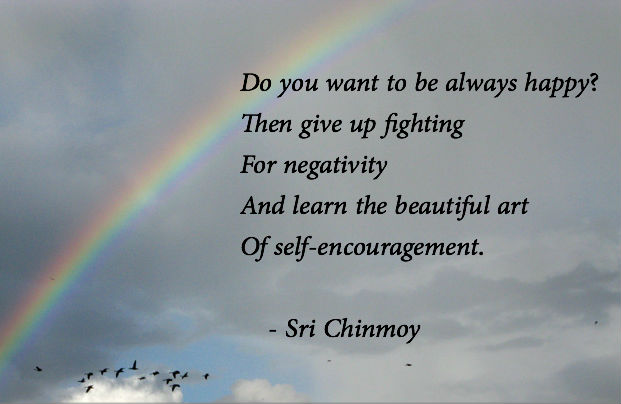
Do you want to be always happy?
Then give up fighting
For negativity
And learn the beautiful art
Of self-encouragement.

Sri Chinmoy [1]

We should feel a negative mindset is a choice. If we feel a victim to our own emotions and thoughts, nobody else will be able to help us. We should feel that by holding on to a negative frame of mind, we are inevitably choosing to be unhappy; each negative is a conscious decision to be miserable. If we really value the importance of our own inner peace and happiness, we will aspire to cultivate this through good, uplifting thoughts. Next time you feel the onset of a depressed state of mind, just ask yourself the question: Do I want to be happy or Miserable?

Spend Time With Positive People

The best antidote to negativity is simply to spend time doing positive, uplifting activities. Sometimes if we analyse and examine our own negativity it does nothing to reduce it. By engaging in useful fun activities, we forget about the reasons for our negativity; this is often the most powerful way to overcome a depressed state of mind.

Continue Reading →

Comments { 74 }

Irrational Thinking and How To Overcome it

sun

One of the biggest problems we have is the tendency for our mind to think in an irrational / unbalanced way. We see issues and other people through a clouded and fuzzy perspective. This judgement leads us to many problems, not least it makes life more stressful and depressing.

These are some of the common perspectives on life which are misleading.

Jumping to Conclusions

Often we jump to conclusions on a small fraction of evidence. Perhaps someone does not reply to our message at a particular point in time, we then project our own thoughts as to why this is. The mind creates a powerful scenario which we come to believe. Yet, our mental projections are often far from reality. To make things worse we often jump to conclusions in a negative way. The mind is suspicious of others’ intentions and we definitely create problems for ourselves by doubting our friends and relatives. We have to be very wary of jumping to conclusions; at the very least we should remind ourself our conclusion is likely to be wrong.

It may be unfortunate to be mistreated by others, but, it is much worse to have a suspicious mind

Black and White Thinking

We often come to see the world in black and white terms – either we are a total success or failure. Other people are either friends or enemies. The problem is that one small mistake can make us feel a total failure. For example, we say one wrong thing so then assume we have messed up a relationship with someone. On the other hand a small success can bloat us with pride. Life is never so clear cut; we have to avoid both the depths of despair and heights of vainglory. Rather than seeing ourselves as a total failure just see mistakes as stepping stones on the path to self-development.

Blaming other People for own Faults.

Often we sit in judgement on other people, but, if we were honest we would realise many of their faults we too share. We are not judging out of compassion but out of a sense of self-importance. The worst thing is when we do something wrong but seek to pass the blame onto other people – If  only other people had done the right thing we would been fine. This is just our clever mind justify its wrong actions. But, with this attitude we will just continue doing the wrong thing and create more problems. We have to be honest with ourselves.

“We are our own fate-makers. To blame others for the unfavourable conditions of our lives is beneath our dignity. Unfortunately, this act of blaming others is one of man’s oldest diseases.”

- Sri Chinmoy [1]

Continue Reading →

Comments { 8 }

Yoga and Self Improvement

sunrise

Yoga is the ancient art of Self-Discovery, and  Self-Realisation. Yoga is a Sanskrit word meaning ‘Union with God’, – ‘Union with the Highest consciousness’. When we talk of Self-Realisation, it means realising the divine nature of our Higher Self, our Inner Pilot. A Buddhist may call it entering into Nirvana, a Hindu may talk of liberation / God-realisation. Ultimately, it is a state of consciousness beyond name and form and the limitations of the mental world. The Upanishads talks of ‘Sat Chid Ananda’ – Existence, Consciousness, Bliss – Our highest Self – a being of pure delight.

Such ideas may seem very far from our present state! Given the limitations of our mind and nature, a consciousness of unbridled delight and peace seem a far cry. Most of us would  settle for just a little bit more peace, a little bit more joy. But, the highest teachings of yoga tell us that there is no end to our inner self-transcendence. – All we need to do is realise the divinity within.

In the West, yoga often invokes images of hatha yoga – difficult postures for calming the physical being and gaining greater peace of mind. But, hatha yoga is only one small aspect of the ancient path of yoga. There is also.

  • Bhatki yoga – the path of love and devotion.  Bhakti yoga doesn’t worry about philosophical discourse and explanations, it merely seeks to love. It is not a human love based on possession and expectation. But, a divine, universal love without expectation or sense of possession.
  • Jnana yoga – the path of wisdom – gaining true insight into our real being; a wisdom which is much more than intellectual understanding. A wisdom that comes from knowing our deepest soul through meditation.
  • Karma Yoga – the path of action. Making progress through selfless service to the rest of humanity. It is selfless service without expectation of reward, recognition. It is egoless work done with detachment to the outcome.

How To Make Progress Through Yoga

Yoga means we make a conscious effort to transform our consciousness. It means facing upto  and transcending our weakness. It requires a faith in God, or at least a faith in our self. It requires patience and persistence and the ability to remain focused on our self-improvement.

Patience, Perseverance.

Patience is sometimes viewed as a negative, or at least static thing. But true patience means ignoring the demands of the ego and accepting the transformation of nature which inevitably takes time. It is a mistake to think the path of yoga is about austerity and a bed of thorns. To seek our real self, is the most rewarding thing we can undertake. But, neither is it an easy downhill path with everything done for us. But, nothing worthwhile is without trials and challenges. We cannot give up at the first hurdle, but must remain committed to yoga, however, bumpy it is. How to be more patient

Enthusiasm.

To make progress in any aspect of life, we need an enthusiastic attitude. It is the same with yoga, we can make the fastest progress only when we value and are enthusiastic about the goal. See: Enthusiasm

Honesty / Self Appraisal.

In yoga we need to overcome the ego. The justifications and excuse of our ego, just make our journey longer. See balance between self-criticism and self-encouragement

Inner Strength.

Yoga is not for the feint hearted, sometimes, you need to go against the prevailing way of the world. We cannot allow ourselves to be sucked into materialistic goals. Yoga doesn’t negate the outer life, but, seeks to give a proper balance between inner wealth and outer wealth. This needs an inner strength to be true to our inner calling.

Simplicity

Sometimes it is the simplest things which matter in yoga. A sincere smile, doing something with love, doing something selflessly – outwardly it may not sound much but it can make a big difference in yoga.

Each smile
Is a radical
Self-improvement.

- Sri Chinmoy

photo: Sri Chinmoy Centre Gallery

(1) Excerpt from Seventy-Seven Thousand Service-Trees, Part 21 by Sri Chinmoy
Comments { 4 }

Is self-discovery a selfish act?

We’ve all heard it before from well-meaning people – that focusing on our own self-improvement is an intrinsically selfish act. That it ignores all the people out there less fortunate than ourselves we should be helping. That it is basically an exercise in narcissism.

Let me say it right from the start – there is absolutely not even a grain of truth in this. And here are three very powerful reasons why:

Reason 1: You have to have it in order to give it

If we do not have inner awareness, or reached a state of inner contentment, then the so-called help we offer to the world will be driven by our need for self-approval and self-validation. We become more concerned about gaining approval for what we have done than about the people we are helping. We may have the outer resources necessary to help others, but we do not have the inner resources to do the job wisely, and with the proper amount of concern and detachement.

The journey of self-improvement gives you those inner resources. It brings to the fore new talents and capacities you never knew you had, and these capacities give you a greater sense of self-confidence as you go out into the world. Continue Reading →

Comments { 5 }

Overcoming jealousy once and for all

Sometimes we get a subtle kind of thrill by indulging in jealous thoughts of other people, thinking that what goes on in the confines of our minds can’t really harm anyone. But for people who are consciously trying to better themselves and grow into their highest potential, indulging in jealousy can infact be a significant stumbling block to inner progress.

Why is that? Well, when we harbour jealous thoughts, we inhabit a mental space that consists solely of the person we are jealous of. In doing so we limit our possiblilities and our view of the world shrinks; we begin blaming other people for our current state rather than doing something about it ourselves.

Jealousy also brings us further away from true awareness of the world, as it invariably always exaggerates the person’s bad qualities, and these exaggerations then become our reality. It acts as a kind of a filter where we often see only the bad things about the person, and not the person as a whole. Continue Reading →

Comments { 6 }

Eliminating your weakness – the positive way

Ecuador

Often we feel that by constantly being aware of our weaknesses and analyzing them to death, we are making progress towards eliminating them. Yet very often the exact opposite is true: by focusing on our weaknesses, we often end up only perpetuating the cycle of misery and self-loathing that these weaknesses inflict upon us, and we in fact increase their hold upon us.

It can be much more rewarding to instead work on cultivating the opposing positive quality as an antidote. This has a number of advantages over merely ruminating on your negative qualities. By invoking positive qualities and seeing the transforming effect they have on your life, you feel a new sense of empowerment and are inspired to continue. Also, we all like adding new things to our life, and each new positive quality we develop makes us feel a fuller, more rounded person. Most importantly, we deprive these negative qualities of the mental oxygen they need to fester inside us.

Here are a few negative qualities and the ‘antidote’ quality to them that you can cultivate; as you can see, it is by no means an exhaustive list and I am sure you can easily think of a few more….

Doubt and certainty

Self-doubt can be one of the most damaging of all our negative qualities, in that it scuppers our attempts at self transformation and often dooms us to failure before we even get out of the starting blocks. Often we are so burdened down with doubt and hesitation that we never make the first move at all. However if we can feel that inwardly we are destined to achieve our goal, then the distance between us and that goal shortens immeasurably. We may stumble time and time again, but the very fact that we are determined never to give up means that these qualities will one day surrender to our will power.

Lethargy and dynamism

This is one very obvious application of cultivating a positive quality. In fact the very word ‘dynamism’ has great power, and just by repeating it over and over again, you begin to feel like a human dynamo, filled with energy and constantly on the move. As you feel it you can try and identify where in your body the lethargy is coming from, and imagine that you are surcharging that area with tremendous energy and enthusiasm.

Jealousy and oneness

Jealousy comes because we feel a sense of ‘otherness’ – i.e. someone else has what we do not, someone else has achieved something and is getting all the credit. In this case, the best antidote is to remove this sense of otherness by instead feeling your oneness with that person. In a way, you can think of the world as a giant family. In a normal family, when someone does something great, the brothers and sisters feel just as proud and happy as if they had done it themselves. Similarly, you can feel the same sense of joy that someone in your global family has done something great – in fact when you really develop this sense of oneness, you can definitely feel the same joy as if you achieved that thing yourself.

Anger and peace

The effect that inner peace has on controlling your anger is something many people find out about naturally when they take up a practice of meditation. For example, I came to the practice of meditation not knowing exactly what to expect. Practically the first thing I found that the ‘trigger spots’ that used to make me see red somehow failed to have that effect anymore – the inner peace I had found from meditation had somehow seeped into my outer life and neutralised much of the temper I had. In fact one meditation exercise you can do is use breathing to cultivate peace; when you breath in, feel that peace is entering and spreading through your entire being, and when you breathe out, you can feel that all the stress, tension and anger is leaving your system for good.

(Photo: Sri Chinmoy Centre Galleries Macedonia)

Comments { 7 }

Self-Improvement Ideas

Rails in the sun

We often look at aspects of our lifestyle and say to ourselves “oh, I wish I could change that”, but the prospect of commiting to change for an indefinite period of time is something we often find quite intimidating! Instead, why not try and embark on a new course of action for a finite period of, say, a month? There is some scientific evidence to support the notion that after about three weeks of doing something, a habit begins to form and you find it much easier to do that thing. 30 days is also a long enough time for you to see the benefits of what you are doing, so that you will be encouraged to pursue it further.

Here are three suggestions – there are many other ideas that would suit a 30 day programme out there, which I may write about in a future blog entry….

A little writing project with a big difference

No, we’re not talking about an essay or a creative composition – we’re only talking about a couple of minutes in the morning where you write down three dreams you hope to fulfill. You might start with writing down some things you hope to get done within the day, but often a spontaneous idea will often come along, or a thing you’ve never done but always wanted to try – write them all down, even if they are impractical at the moment or cannot be fulfilled immediately. The very act of writing generates a spontaneous energy to go out and fulfill the dream; it might not be realised overnight, but at least on that day you have begun to take the first step. Continue Reading →

Comments { 4 }

When and How Should We Criticise Others?

snow

Criticising others is a tricky business because people are rarely receptive to criticism. However, there are ways to point out mistakes to others which will make them more amenable to taking on board our suggestions. But, whilst it can be important to point out the mistakes of others, it is equally important that we avoid becoming a full time critic. If we spend all our energy on judging and criticising others we will just become a negative person and do nothing to effect real change.

Tips on Effective Criticism

1. Avoiding Unnecessary Criticism

We are apt to criticise unnecessarily. It is as if we are drawn to the faults of others and forget the good things they do. Criticism rarely helps a situation; when we criticise people they invariably feel miserable and when they are unhappy they are unlikely to lead better lives. If we can avoid criticising others we should. It is also important to avoid feeling responsible for the way others lead their lives; if you think a friend is too carefree with spending money, it is not necessary to keep criticising them for it. To a large extent, we have to give people the freedom to make their own choices in life. If we constantly criticise others it suggests that we want to direct their lives for them, something we should avoid doing.

Those who serve the world constantly
Do not have time
To criticise others,

While those who do not serve
Others selflessly
Have endless time
To criticise the whole world.

- Sri Chinmoy

2. Avoid Criticising inwardly

Quite often we spend a lot of time criticising others inwardly. We may not say it in words; but our thoughts are filled with criticisms of other people. When we think negatively about other people we do nothing to change that person; the only thing we achieve is to become negative ourselves. If we spend our mental energy in criticising other people we will not get any abiding feeling of satisfaction; we will certainly not become a better person ourselves. What happens when we criticise others is that the ego feels a sense of superiority. We criticise others to make ourselves feel better; but, this feeling of superiority only gives a pseudo happiness based on a sense of ‘being a better person’. True abiding happiness will come when we can feel a sense of oneness with others. When we identify with others we seek to focus on their good qualities and forget their mistakes.

  • Be careful about criticising inwardly – would you be happy for your thoughts to be made public? Try concentrating on holding thoughts you would not be embarrassed to share outwardly.

3. Offer Encouragement

A clever way to criticise is to offer encouragement for good things that people have done. If you offer sincere encouragement and praise then people will be much more receptive to hearing criticisms and suggestions for improvements. This is not about offering false flattery; it is about having a balance between praise and criticism. If you only criticise and point out people’s faults, this is unbalanced and people will lose their self confidence. Everyone is a mixture of good qualities and bad qualities; encouraging their good qualities is the best way to diminish their mistakes and bad qualities.

Continue Reading →

Comments { 8 }

7 Secrets of Self improvement

clouds

Self improvement is a continuous struggle to better ourselves; it the aspiration to transcend our weaknesses and limitations. There is no quick fix for our self development; it requires perseverance, patience and a constant aspiration to lead a better life. These are some of the factors that will expedite our progress.

1. Don’t Just Talk

It is easy to spend several hours reading and talking about making changes to our life. But, all the books in the world won’t help unless we can make real changes to our life. Books can give us inspiration, but, for every book we read it can take many years to actually understand and implement the changes in our lives. Similarly it is good to talk and articulate what we should do, but the real test is whether we can practise what we preach.

2. Discipline / regularity

Self improvement is not something that can do once a week when we feel like it. Self improvement requires a certain discipline and regularity. For many discipline brings to mind negative connotations of doing something we don’t really want to. However, the discipline here is really the motivation to continue doing the right thing. If something is good to do, there is no need to just do it occasionally. After a while our discipline to create good habits, no longer feels like discipline; we want to do it simply because this is what we enjoy doing. Our bad habits no longer seem attractive.

3. Think of others

Self improvement doesn’t mean we focus excessively on ourselves. It is a paradox of self improvement that real progress comes when we give less importance to our ego and give more consideration to others. When we think of others a little more and ourselves a little less, we will definitely make progress in becoming a better person.

Continue Reading →

Comments { 4 }

How The Power of Selflessness can Transform our lives.

holdfast

“Wisdom ceases to be wisdom when it becomes too proud to weep, too grave to laugh, and too selfish to seek other than itself.”

- Khalil Gibran

Is it possible for man to be completely selfless? A cynic may say not. But, selfless actions and thoughts are not only possible, but give a real sense of satisfaction and abiding happiness.

What do we mean by real selflessness? Selflessness means we act without thought for how we will profit or be rewarded. If we give help to others, but expect recognition or the favour to be returned, this is not a selfless action. True selflessness means we would do the action, even if it was never know to anyone else. Selflessness means we identify with others. Our service to others is not an act of condescending charity in helping others, our action is motivated by a feeling of oneness. We help others because we identify with their problems and their suffering. Selflessness is its own reward.

Benefits of selflessness

Conquers Pride.

In a true selfless action we are not acting to feed our ego and receive the flattery of the world; we are not acting out of competition or desire to prove ourself to others. Selflessness means we act out of a motivation to do the right thing and help others. By definition, selflessness cannot involve inflating our ego, it does exactly the opposite.

Continue Reading →

Comments { 8 }